Krishna Kids: Battered in the Name of Godhead
A report by David Feller published in Hustler magazine (February 1991)
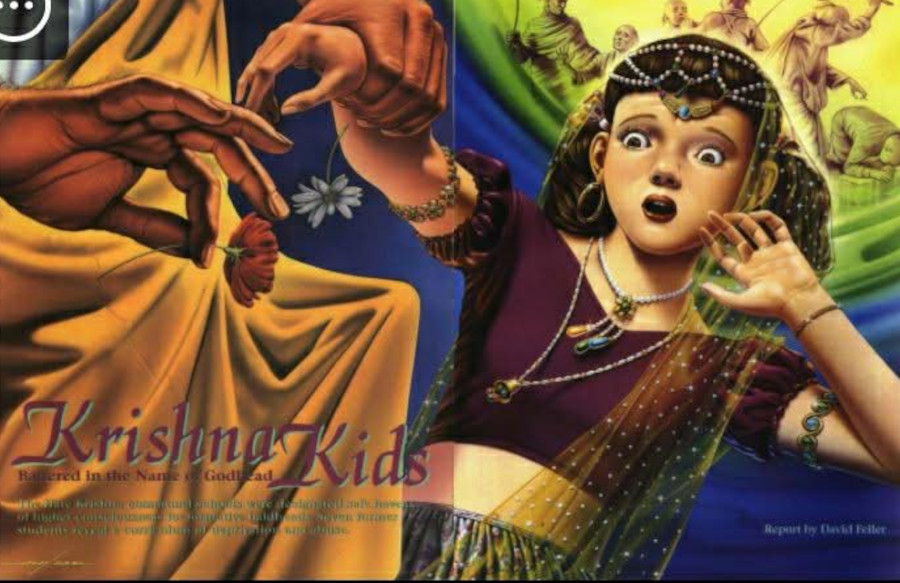
Image from the article “Krishna Kids,” showing a fearful Krishna girl forcibly restrained by a man with an erection under his saffron, sannyasa robe. In the upper right-hand corner are depictions of teachers beating students.
Introduction by Henry Doktorski: This article appeared in the February 1991 issue of Hustler magazine. [Endnote 1.] It is one of the first published articles about child abuse in ISKCON, and in my opinion, it is mostly accurate, although there are errors of exaggeration.
Our friend, Vrndavan Brannon Parker (b. January 22, 1967), who spent his entire childhood in Krishna communes and who was interviewed by the Hustler writer, provides some background about the origin of this article. He and his sister Kunti devi (Jennifer) lived at New Vrindaban from 1978 to about 1982. Vrndavan explains:
How it came about? My fellow gurukuli, Vakreshwar (Billy Bose), who I met in New Vrindaban in 1971 when I was 4 years old, is the son of the late Brishakapi dasa. Vakreshwar had a writer friend. In late 1989 or early 1990, Vakreshwar’s writer friend called me up and interviewed me by phone. He did not mention Hustler magazine. I think he claimed he was writing a book. I then gave him phone numbers for the other gurukulis who he interviewed.
Then in early 1991, Raghu [Raghunath dasa/John Giuffre, an ISKCON gurukula alumnus, who is called Ragz in the article] calls me and tells me about the recently-published article in Hustler magazine with our interview about our trauma during our time in the ISKCON gurukulas. He tells me that GBC members are outraged and want to sue us. I got angry and said I would countersue the ISKCON GBC.
However, a Prabhupada disciple friend, Nishcintya Higgins, supported us and told us not to worry about it. He told us he was proud of our willingness to expose the criminality in ISKCON. Ironically, I was never mentioned once in the article, although some of my thoughts appeared.
My sister Jennifer (Kunti dd) Parker felt, as our interviews were published in a Porno Mag, it was an additional layer of the abuse cycle she had been subjected to. She was also upset about some inaccuracies in the article.
I shared this 1991 article with Henry Doktorski because he is now the world’s leading eminent historian on everything related to the tragedies connected to ISKCON.
Vrndavan Brannon Parker ACBSP
Waimanalo Village, Hawaii
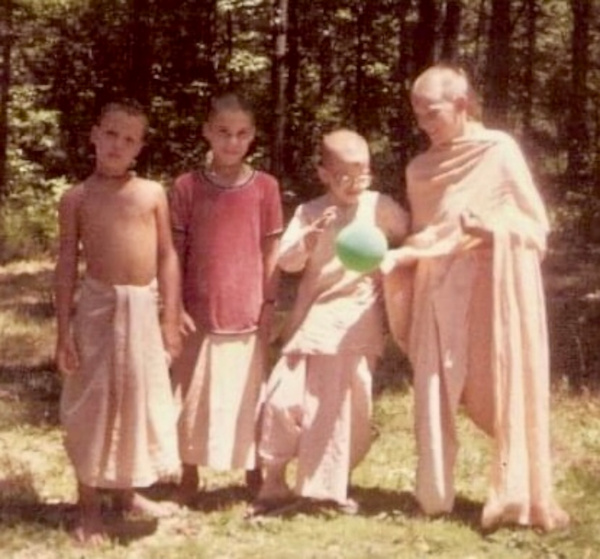
Four boys at the Gita Nagari ISKCON farm, Port Royal, Pennsylvania (1979). Twelve year old Vrndavan Brannon Parker is on the right.
Krishna Kids: Battered in the Name of Godhead
A report by David Feller published in Hustler magazine (February 1991)
At 12, Jennifer Parker was married—to a man in his 20s, whom she had never met. When she refused to talk to him, she was beaten. Her friends were married to men over 40, and they were beaten for not having sex with their husbands. [Endnote 2.]
At 13, Lisa Weltmer wed her second husband. She wasn’t given much choice in the matter. He tried to rape her, and he fractured her ribs in one of their regular spats. Before she was 18, Lisa had tied the knot a third time and had two children. She went through her first labor alone, on a barn floor—at the age of 15.
At least nine girls, most of them 11 or 12, were railroaded into strange June-December tie-ups with adult men. These young girls had fallen into the hands of the International Society for Krishna Consciousness, ISKCON—popularly known as the Hare Krishnas—and were victims of the movement’s abusive school system. [Endnote 3.]
Jennifer Parker’s little pals, coerced into bed with middle-aged Romeos, thought that Jennifer was lucky. Since her groom did not follow the common Krishna practice of shaving his head, her school chums told her, “At least yours has hair.”
In the beginning, it wasn’t meant to turn out that way. In 1965, Indian spiritual master, His Divine Grace A. C. Bhaktivedanta Swami Prabhupada, a direct disciple of God—Krishna—“landed in Manhattan with saffron robes, a suitcase and $7,” a follower wrote, and begged money in the streets to pay rent on a little storefront temple on the Bowery. He only knew one tune, “Hare Krishna, Hare Krishna,” and so forth. His dance routines were limited to the “Prabhupada step,” the familiar one-two Krishna rag. And he wasn’t much to look at. But the swami had a hit on his hands.
It was the ’60s. Fed up with “the system,” protesters, freaks, college students and pop icons joined Krishna’s chorus line. Prabhupada and his mantra hit the top of the charts, when George Harrison recorded it on the Beatles’ Apple Records. The septuagenarian heir of God took his show on the road, and San Francisco’s Avalon Ballroom booked him to headline an all-star concert, with the Grateful Dead, Big Brother and the Holding Company, Moby Grape, Allen Ginsberg and Timothy Leary doing the warm-up.
Prabhupada sent out missionaries to people the earth with happy worshipers. Under the battle cry voiced by one temple president, “We will try anything to trick people into . . . Krishna consciousness,” apostles went to Europe, Canada, all over the U. S. and even back to mother India. ISKCON’s membership rose to an estimated 3,500. Onward, Krishna soldiers!
By the guru’s direction, the first Krishna school, or gurukula (pronounced “gura-cool”) was set up in Dallas in 1971, a “school designed to produce great men,” the leaders of a “nice” world.
Krishna-conscious parents got the word about the horrors of worldly, or karmi, schools, and the transcendental good vibes of gurukula, where “developing pure love of God is great fun.” The kids came in for something else, a weird psychology experiment that might have been carried out by Dr. Frankenstein.
Seven Krishna-raised young people, ranging in age from 17 to 26, are hungry to speak of the experience. Ragz—that’s his Krishna nickname—now 24, says, “You’re the first person interested in hearing the gore and wonder of the children of the Hare Krishna movement.”
It began in Dallas, Texas. Joseph Fournier, 26, “the first gurukula boy to join the temple,” remembers that the eats weren’t much. The people who ran the place weren’t into “unnecessary sense gratification.” The kids had to fast—their souls were more important than food. “That’s why we’re all pretty lean,” Joseph says. “We all looked like little crickets, with our shoulder bones that stuck out.” Adds Ragz: “They made me fast for three days because I would not eat my dahl [bean dish]. Dahl was so disgusting. And if you didn’t eat it, they would save it for the next meal, and so on. Four days, they didn’t let me eat. I was so hungry, and this dahl stunk so bad by then. It was putrefying.”
Joseph’s brother David, who goes by his Krishna nickname Devz, remembers a teacher who made him choose his own punishment, either to be whipped or to go without food. “We’d be sitting there, and he’d have the plate in front of me, but I’m not supposed to eat. I’m supposed to be chanting. I’d get one grain of rice, and I’d roll it up my sleeve. Somehow I’d get it in my mouth and still be chanting. The next day in japa [chanting] period, I’d be throwing up, right in the middle of the temple room. It was all water, there was nothing else coming out.”
Beyond the austerity was craziness. The teachers, “good old American cowboy-type” people, were giving up meat, sex and sleep, and waking up at three or four in the morning to chant. The ashram (“dormitory”) teacher had to live with 15 kids night and day. Things could get very serious very fast. “One time this red-haired guy, Mohonananda. . . . This guy was crazy,” Devz relates. “He was threatening to cut off my ear. He was on top of my chest with his knees, pulling my ear, and he had this knife there. I was freaking out. I was holding his hand back. That was the most traumatic thing that happened in Dallas.”
When the Texas gurukula closed in the mid-’70s, the scene shifted to India—Mayapur, and then Vrindaban, near Delhi. “We were animals,” says Damian Weir, 19. “India is the worst. In Vrindaban, I was beaten every third day, by bamboo stick or by hands. I was only nine and ten. It was like a jail. There were bars on the windows. All we ate every day was rice and beans, and one piece of fruit. And there were worms—this isn’t just talk. You could sit there on any particular day and pick little white worms out of your food.”
“To really understand the horrors of India,” Ragz tries to paint the picture: “No water, in the middle of the desert, no electricity. You cannot imagine how tortuous it is to be thirsty, and the only water available is salty. One time I was sick with malaria. There were five of us. Three had temperatures of over 105 degrees. Anyway, the bathroom at that time. . . . practically every stall was filled up with crap, every toilet. And there is no water on top of it.”
But the real Krishna-conscious shit was in the mind, according to Devz: “I don’t mind punishment, if it’s right. But mind games and submission—it was too much.”
Devz committed the sin of not paying attention. “[They thought], this guy is doing something else in his mind. They didn’t like that.” One teacher, Manihar, Devz recalls, “really did like to break me. So he had all the kids pick up shoes and beat me. [Endnote 4.] I never broke a bone or anything, but it’s the most painful thing to see how this guy could turn all your friends against you. It was hellish for them too, having to do something like that.” [Endnote 5.]
Ragz was being groomed for leadership; he was a sort of student torturer: “I was probably one of the most brutal monitors in the history of our movement.” One of his victims was Devz. “I organized a whole system of breaking the guy down psychologically. I said, ‘Yeah, let’s put him in the bathroom, that will humble him.’”
The bathroom was were 40 or 50 kids beat their clothes clean every day. All that dried, crusted soap had to be scrubbed away. “You’d have to use a toothbrush or take a razor blade,” Ragz continues. “to clean the tile work could take hours. Not to mention the grossness of cleaning out the stool that kids spray through the entire area of the bathroom floor. So I just worked up a program.” Devz cleaned the bathroom every day before breakfast.
Why was Ragz so brutal? “There was a kind of competition to smash the spirit of any retaliation. That was the way our teachers worked. I wanted to be the most popular and powerful teacher. I wanted to kick ass and reform these kids. I did it very expertly,” Ragz says. “I could really break people down and get their loyalty.”
Early on in life, Ragz was “dragged in” to the Krishnas. “My mother kidnapped me from my grandfather,“ he says. Devz had a softer childhood. People remember his mother for her gentleness. As a gurukula teacher, Ragz says, “She could discipline the kids without raising a finger, practically.”
Recalls Damian Weir: “India was the bad one. The kids couldn’t wait to get out. It was like deliverance from hell.”
In New Vrindaban, things truly went to hell. The Krishna commune in the green hills of rural West Virginia was supposed to be where “the kids can play with cows, pick berries and play the pastimes of Krishna.” It was also where the “Palace of Gold” was going up, and where cops were digging up corpses, and kids were infected with parasites and neglected (at least three died in accidents). One teacher was thrown in the slam for sucking off students.[Endnote 6.]
Another one, who allegedly took little guys on his lap and casually butt-fucked them in front of the class, took it on the lam to India. He finally returned and faced charges, but he was acquitted. [Endnote 7.]
New Vrindaban was the domain of one of Prabhupada’s original disciples from the first temple on the Bowery. His real name is Keith Ham, but he goes by Kirtanananda Swami Bhaktipada. The most stomach-turning photo of Ham shows him with his reputed lover, a post pubescent, shaven-headed boy with hollow eyes reminiscent of Holocaust survivors, supposedly the son of Ham’s former homosexual partner and best friend. [Endnote 8.]
Damian Weir remembers the Palace of Gold as a teenager: “I was forced to work to help the Palace. There was no choice, no money. I was building fences, big fancy gates, waterproofing the whole ceiling. During the winter, there was no ride home. By the time I got home, I couldn’t feel my face or my fingers, because they didn’t even give us proper winter clothing.”
Shannon Welton, 19, was seven when she first went to New Vrindaban. She recalls the odious sanitary conditions of the gurukula: “There was no toilet paper. You wiped with your hands, and you ate with your hands. There was a really bad cockroach problem. Once I had to eat my oatmeal, and I ate cockroaches.” Cow piss and shit were all-purpose products. The stuff was used to “sterilize” the food buckets. “You could wash a bucket out with urine, or the stool, and it would be considered clean. That was like the soap.”
When seven-year-old Shannon wet the bed, “[The teacher] would make everyone pee in my mouth. Everyone was scared. She’d lay me on the ground, and she pulled their pants down. They wouldn’t, so she pulled them down. She’d squat them over me and say, ‘Now pee in her mouth.’ She was yelling. But no one would. She’d hit them all, and she said, ‘I’ll show you how it’s done,’ and she did.”
Kirtanananda Bhaktipada, or Keith Ham, is enshrined in Shannon’s memory from the darshans, or offering ceremonies. “You’d sing to him, and you’d offer him things, like incense and flowers. He’d throw cookies back at you. Everyone would crawl on the floor to get cookies. There were supposed to be special cookies.”
Jennifer Parker, 21, remembers Kirtanananda too. “When you see him, you’re supposed to bow down, just in awe.” When she was nine, Jennifer was left at New Vrindaban by her mother. She tells us that is was common to marry girl children to older men. “If someone wanted to get married to a young girl, they’d marry them to her to keep them there.” At nine she was courted by an adult—Ralph Seward, or Radhunath. [Endnote 9.]
Commune leaders wouldn’t let him marry her, because “he didn’t have any power. But he used to bring me gifts, animals, rabbits, baby birds he found without moms, stray cats. He knew I liked animals. Once, our toilet wasn’t working. We ran out into the field to go to the bathroom, and he was out there. I was already undressed, lifted up my dress to go to the bathroom, and he was standing right there, which scared us, because it was a woman’s area. What was he doing there? He told us that he was chanting his round, japa.”
Jennifer’s friend Jannapuri was 11 when she was married. “They made her marry someone, and every time he came over, he was pleading with her to try to get her to do it, what she was supposed to do,” Jennifer recalls. And on one occasion, “I thought she had her period. She was really upset; she was bleeding. She wouldn’t tell me why, and she just laid down and didn’t talk about it.”
Jennifer herself was married to Jayadeva. At least she thinks that was his name. She was 12 and had not reached puberty. The bridegroom was in his late teens or 20s. “He was very rich. If someone had money, they had their way with people. He used to give me gold necklaces and stuff. I gave them to other girls.” The young man suddenly went from wearing the yellow clothes of a bachelor to the white of a husband, and eventually Jennifer realized that she was considered married to him, “without me even knowing it. I refused to talk to him. So one day this teacher got mad and slapped me. [Endnote 10.] They did things like that to get me to cooperate. Finally, as a threat, she told me I had to leave, thinking I would have nowhere to go. I was kicked out. But I had made friends with some people who lived near the property. They arranged to contact my parents, and they got me out of there.”
Jennifer escaped New Vrindaban. Lisa Weltmer, whose story is typical, did not. Lisa was married when she was 12. (The ceremony included “switching flowers,” an exchange of garlands.) At 13, she was expected to have sex with her husband, who was four years older. But she “rebelled a lot. I wouldn’t let him touch me, and I’d lock him out of the room. So after a while he started beating me up. If he hit me, I’d hit him back or throw things at him. I wouldn’t let him come near me. When Bhaktipada found out, he realized that it wasn’t going to work; so he called it off.”
But soon afterward, she was a wife again. “When I turned 13, there was this teenage boy who had problems sleeping with other married women. Bhaktipada asked me if I would help him out by marrying this boy. Well, I said okay, you know? Bhaktipada always told me I was one of his favorites, but he told thousands of girls that.”
This young rake, Kalanidhi, started hitting Lisa too—standard seduction practice in Bhaktipada’s Krishnaland. “Bhaktipada wasn’t against hitting your wife,” Lisa tells us. “He said if you have to set your wife straight, do it. You slap your dog on the nose and hit your wife on the cheek. His attitude was that every now and then, your wife needs a good beating.” [Endnote 11.]
Eventually Kalanidhi “took me out way back in the very back pasture. And he said, ‘Well, this is it, take your clothes off.’ And I said, ‘I’m not lettin’ you touch me.’ He came at me. I kicked him in the nuts, and I went screaming down the mountain. I had to run about a mile.” She made it to the barn where she worked, and a friend hid her in a pickle barrel. When Kalanidhi got there, he “threw the boy against the barrel. I was sittin’ right there in the barrel listening to it all.”
After more of the ups and downs of a typical 13-year-old girl’s marriage—Kalanidhi fractured Lisa’s ribs in one scrimmage—she began dating a man in his 20s, Pavitra. When Kalanidhi wanted to take her to California, she felt that she “would have been a prostitute.” So she “jumped into a marriage” with Pavitra. She managed to remain a virgin for a while, but just after her 15th birthday, there was a movie Lisa wanted to see in town. She made a deal with her husband—the movie date for sex. “When it came time to do it, I was real scared, and I kind of went back on my word. And he said, ‘Look, you’ve been holding me off for so long. If you don’t do it, I’m going to tell Bhaktipada you’re wrong for me.’ He [Bhaktipada] would have kicked me off the farm. Where would I have gone? I was only 14 or 15 years old. So I laid down, and he did it for about two seconds, and that was it. [Endnote 12.] I ripped a lot; so I had to go in the hospital, because I was hemorrhaging.”
After one or two Krishna quickies, Lisa was in a family way. “He said he wouldn’t get me pregnant.” When she was eight months along, her husband hit her in the head with a board. She began to bleed, to miscarry. When she went into labor, she didn't want to go to the local hospital were she’d had prenatal care. “The doctors there were really mean to me, because I was a Hare Krishna. They hurt me when they did tests and stuff, and I just refused to go. I didn’t tell anybody I was in labor. It went real tough. It took ten hours. Someone found me on the bathroom floor when I was about ready to give birth, so they ran and got the nurse. And she made it just in time to catch the baby as it came out.”
Lisa and all these kids ended up where they were because their parents gave up the children to save them from the degradation of godless modern America. Today, these kids are strangers here. They stick together and understand one another. They room with each other, have dates and sex with each other, marry each other. Joseph Fournier says, “You don’t really have ‘world skills,’ like for supporting your family. The only thing you really know how to do is sell.” Joseph’s brother Devz says, “We were thrown into submission. Being told you’re gonna be a bum your whole life, you’re gonna turn into one.”
For Ragz, it’s been rough. He was the true believer. Now out of the temple, he still calls himself “a very inseparable devotee of Krishna.” He spends a lot of time trying to figure things out. “He loves to mull over all this,” says Joseph. Ragz puts out newsletters and tries to stay in touch with other Krishna kids. With no work background (“I’ve only been preaching my whole life”), he has gone on welfare.
He has a deep need to explain to others and to himself how a heaven-sent way of life ended up smelling like a Tijuana sewer. “People do strange things for love,” he says. It all sounds like the love practiced in a big dysfunctional family. Yet most of the young guys are exuberant, exploding with laughter, high on life. Joseph Fournier tell why: “The suffering is temporary; the happiness is temporary. Since it’s temporary, you should not be down. Even when you’re down, you should be enthusiastic and not project suffering. You should uplift them some way, everywhere you go, so they’ll say, ‘Hey, that guy was happy.’”
The women got the grimier end of the shit stick. “I’m completely illiterate,” Jennifer says. “That’s something I’m still pretty pissed off about.” At 21, she can read a little, but doesn’t “write too good.” It makes it hard to support her six-month-old baby. “Some kids, mostly the boys, came out pretty educated. But [the teachers] really make you feel stupid. They suppress you. You’re afraid to say something, ’cause you think you’re gonna get smacked. When I came out of it, I went to psychiatrists for years. I tried to kill myself about five times.”
“I feel it ruined my life,” says Lisa. “I mean, I went [to New Vrindaban] at ten years old. In the period of 12 years, I’ve been married three times, and I’ve had two kids. I have no education. I had no self-esteem when I first left. I had nowhere to go. I couldn’t even read. I was trying to survive with my kids; I didn’t want to leave them there and let the same thing happen to them. I wanted to be someone who could live on their own.” [Endnote 13.]
Kirtanananda Swami Bhaktipada could kiss her ass.
They’d broken her—the near rapes, beatings, children. She didn’t have the education to make it in America. Hare Krishna is all she knows. At last report, Lisa is back in the movement.

Cover image detail.

Cover image detail.

Cover of the February 1991 Hustler magazine.
Endnotes by Henry Doktorski
Endnote 1: Hustler is an American pornographic magazine published monthly by Larry Flynt Publications. Introduced in 1974, the magazine grew from an uncertain start to a peak circulation of around 3 million in the early 1980s. Hustler was among the first major American-based magazines to feature graphic photos of female genitalia and simulated sex acts, in contrast with relatively modest publications such as Playboy.—Wikipedia
Endnote 2: “Her friends were married to men over 40.”—This is a gross exaggeration. All of the dozen or so girls at New Vrindaban were married to teenagers or men in their twenties, except for one eleven-year-old girl who was married to a thirty-year-old man. He was the oldest.
Endnote 3: In an April 11, 1973 letter to Satsvarupa dasa Goswami, Bhaktivedanta Swami Prabhupada wrote, “I am concerned that the Gurukula experiment should come out nicely.” Unfortunately, Prabhupada’s “experiment”, as noted by David Feller in the article above, was not so much an experiment that produced great men, but more akin to Dr. Frankenstein’s experiment.
Regarding child marriages for young girls, Prabhupada insisted that was the Vedic Way. One of the purposes of the New Vrindaban Community was to establish varnashram dharma in the west, and that meant getting teenage girls married off to older husbands at an early age. Child marriage was common in most societies in the ancient world, but modern society considers it a form of rape or incest. Child marriage was outlawed in India in 1929. Bhaktivedanta Swami Prabhupada advocated child marriage, and wrote about it as early as 1958:
The first principle is this: that one should be completely aloof from all womanly connection save and except his own married wife. In that sense child marriage is most convenient form of morality and there are many examples in the noble life. . . .
The system of child marriage prevents both the man and the woman falling into immoral connection with the opposite sex. Psychologically both a boy or a girl develops the sex-consciousness at the age of thirteen to eighteen years of age according to different climatic conditions. In such stage especially after the attainment of puberty a woman wants a male and if she is not married within that time and allowed to mix up with boys who have developed the sex consciousness, it is quite natural that there is every chance of fall down either by the boy or by the girl. With the change of social conditions, the standard of conjugal life is also changing but the code of avoiding unholy connection with woman is always there.
You cannot indulge in unholy connection with the opposite sex because the social conditions have changed. Because unholy connection with woman is the beginning of all immorality. There are thousands and one examples in the history of mankind as to how a great man fell down simply by illegitimate connection with woman.—Abhay Charan De (soon to become A. C. Bhaktivedanta Swami), “Standard Morality,” Back to Godhead, Vol. 3, Part 14 (November 20, 1958).
When Bhaktivedanta Swami came to America, he attempted to get all his female disciples married. A boy, he reasoned, did not have to get married as long as he remained strictly following brahmacharya. However, if a man was unable to practice strict celibacy, he had to marry, but this showed spiritual weakness. But all women should be married, as Prabhupada did not think they were capable of maintaining strict celibacy. Prabhupada spoke to his disciples about child marriages, especially for girls:
And the psychology is the girl, after first menstruation, she enjoys sex life with a boy, she will never forget that boy. Her love for that boy is fixed up for good. This is woman’s psychology. And [if] she is allowed to have many [boyfriends], oh, she will never be chaste woman. These are the psychology.—Bhaktivedanta Swami Prabhupada, room conversation, London (August 15, 1971).
Sex life, sex urge is there as soon as twelve years, thirteen years old, especially women. So therefore early marriage was sanctioned in India. Early marriage.—Bhaktivedanta Swami Prabhupada, room conversation, London (August 15, 1971).
Educate the girls how to become faithful, chaste wife and how to cook nicely. Let them learn varieties of cooking. Is very difficult? These two qualifications, apart from Krishna consciousness, materially they should learn. There are many stories, Nala Damayanti, then Parvati, Sita, five chaste women in the history. They should read their life. And by fifteenth, sixteenth year they should be married. And if they are qualified, it will be not difficult to find out a nice husband.—Bhaktivedanta Swami Prabhupada, room conversation, Bhubanesvar (January 31, 1977).
“As soon as a woman attains the age of puberty, she immediately becomes very much agitated by sexual desire. It is therefore the duty of the father to get his daughter married before she attains puberty.”—Bhaktivedanta Swami Prabhupada, Srimad-bhagavatam, 4.25.42, purport.
Bhaktivedanta Swami Prabhupada spoke about his own arranged marriage to an eleven year old girl:
Formerly, when I was married, my wife was eleven years old. So (laughing) an eleven years old girl and I was at the same time twenty-one, twenty-two. One day I captured her hand. She began to cry. A little girl, you see? So gradually, gradually.—Bhaktivedanta Swami Prabhupada, morning walk, Bombay (April 12, 1974).
I was married, my wife was eleven years. I was twenty-two years. She did not know what is sex, eleven years girl. Because Indian girls, they have no such opportunity of mixing with others. But after the first menstruation, the husband is ready. This is the system, Indian system.—Bhaktivedanta Swami Prabhupada, room conversation, London (August 15, 1971).
Practically, I’ll say, in our childhood age, my sisters were married between nine to twelve years. My eldest sister was married when she was nine years old, before my birth. She is the eldest. And my second sister was married at the age of twelve, twelve years. And my third sister was married at the age of eleven years. So by the (indistinct) twelve years, the marriage must be finished. That was the duty of the father. I remember, because my second sister was going twelve years, my mother said to my father that “I shall go to the river and commit suicide. The daughter is not married.” (laughter) You see. The father was very sorry, “Yes, I am trying. What can I do?” (laughter) . . . I was also married man, you know. I was married when my wife was only eleven years old. And at the age of fourteen years she gave birth to first child. And next generation, when my eldest daughter was married at the age of sixteen years—it is little increased—but I was also very much upset that the daughter is sixteen years old.—Bhaktivedanta Swami Prabhupada, lecture, Srimad-bhagavatam 1.8.51, Los Angeles (May 13, 1973).
All my sisters were married within twelve years. My second sister, she became twelve years, and I heard my mother become so disturbed: “Oh, this girl is not being married. I shall commit suicide.” (laughter) Twelve years. And she was given to a boy, my brother-in-law, for the second marriage. Means that my brother-in-law lost his first wife, and still, he was twenty-one years old. My sister was twelve years old and brother-in-law was twenty-one. In the sastra... I do not know exactly what is that sastra, but they say that if the girl before marriage has menstruation, then the father has to eat that menstrual liquid. Means it is, mean, very strict. And if the father is not living, then the elder brother has to eat. [break] ... of getting the girl married rests on the father. In the absence of the father, the eldest brother. The girl must be married. That is it. It is called daya, kanya-daya.—Bhaktivedanta Swami Prabhupada, morning walk, Mayapur (February 9, 1976).
In the last quotation, Bhaktivedanta Swami Prabhupada was referring to Mahabharata, which says, “Let the man of thirty years wed a ten-year-old wife, a nagnika (one that has not yet menstruated), or let the man of twenty-one get one seven years old.” Child marriages were arranged before a girl reached puberty, supposedly to prevent her from having illicit affairs with men, as it was believed that a girl’s desire for sexual intercourse is nine times greater than that of boys. Prabhupada explained, “It is understood that the sexual appetite of a woman is nine times greater than that of a man.”—Bhaktivedanta Swami Prabhupada, Srimad-bhagavatam, 3.23.44, purport.

Child marriage was the norm in India for thousands of years, until the Child Marriage Act of 1929 propelled India into the 20th century and made the practice illegal.
Endnote 4: On February 1, 1977, during a morning walk in Bhubanesvar, India, when asked if a child should see the benefit of going to school, Bhaktivedanta Swami Prabhupada replied, “Child cannot see. He’s a rascal. He should be beaten with shoes. Then he will see.”

Endnote 5: Manihar (Matthew Norton) (1953-2009) was one of New Vrindaban’s most notorious teachers. He served as the headmaster of the Varnashram College at New Vrindaban from 1981-1983. At the age of 29 or 30, he befriended a nine-year-old orphan girl. The girl remembered, “He adopted me. He was going to be my father. He would take me to his house on the weekends sometimes. He molested me from 1982 to 1983. He would undress me and put me to sleep, and tell me that he loved me, and that he would never do anything to hurt me. But he would fondle and play with me all night. He touched me all over. . . . Once he took me to Los Angeles with him, and one night we were staying in this apartment, and the whole night he was sticking his fingers in me, and he put me on top of him. And he was rubbing my body against his. And I felt a sharp pain, and when I woke up in the morning there was blood everywhere.”
When Manihar left New Vrindaban, he served as a teacher at the Bhaktivedanta Gurukula in Vrindaban, India. Around 1984, Manihar defected from ISKCON and established a home for orphans (street children) in Bombay, and later in Vijayawada, Andhra Pradesh. He wrote a manual on the proper care of street children, which was widely acclaimed in India. In 2008 he received the prestigious Annual Award from the All-India Rotary Internation for his outstanding service to children. He suffered from osteoporosis and ingested morphine to help relieve the pain. In June 2009, he collapsed in his home at the age of 56 and died. Inside sources claim he died from a morphine overdose.

Manihar, at the time the headmaster of New Vrindaban’s Varnashram College, chants with some of the students at Prabhupada’s Palace of Gold (Autumn 1981)


Obituary for Matthew Norton (2009).
Endnote 6: This was 19-year-old Lalita Madhava (Yurumid Noriega, AKA Frederick Lawrence Difrancisco). He was not a teacher, but a teacher’s aide, who came to New Vrindaban eight years earlier when he was eleven. His mother was Adhara devi dasi (Elba Noriega), an elderly white-haired lady who worked in the sewing room at New Vrindaban. She received diksa in Caracas Venezuela in August 1974. In November 1987, she took sannyasa from Bhaktipada and became known as Ananta Swami.
Yurumid Noriega was born February 5, 1967, in Venezuela. Adhara and her son came to New Vrindaban in August 1978. Apparently she thought that New Vrindaban, a Krishna conscious ISKCON farm community with the motto “Plain Living, High Thinking,” as proclaimed by the propaganda publications Back to Godhead and Brijabasi Spirit, would be an ideal place to raise her son to become a self-realized devotee, as her spiritual master had warned that nondevotee schools were “slaughterhouses for the soul.”
When Yurumid Noriega first came to New Vrindaban, he was given the name Dhira Lalita. He was one of the four or five boys who lived with me in my tiny cabin at the Old Vrindaban Brahmachari Ashram during the winter of 1978-1979. I thought he was a normal kid. He received diksa and the name Lalita Madhava dasa from Bhaktipada at the Palace dedication festival (September 3, 1979). In the 1980s, he acquired a fictious name and identification card, Frederick Lawrence Difrancisco, probably because his visa from Venezuela had long expired. Frederick Lawrence Difrancisco was a real person born in the late 60s (about Lalita’s age) who had died as an infant. Years later, during a telephone conversation with me on July 21, 2003, Lalita Madhava confided:
I came to New Vrindaban in August 1978 with my mother and was immediately put in the gurukula. I was about eleven years old at the time. The older boys, such as Samba, Keshi Dhama and I, would go to school at Nandagram in the mornings and do service at Bahulaban during the afternoons. Most of the time we lived at Old Nandagram, but one summer Kirtanananda had us stay in the brahmachari ashram [at Bahulaban]. After finishing our afternoon services, we’d shower up and attend the evening aroti.
I remember several times, Kirtanananda invited me and another boy to take a shower in his personal bathroom in his suite on the fourth floor of the ashram building. He had a brand new bathtub which was recently installed. To my surprise, he told us to shower together, completely naked, and he insisted that we keep the shower curtain open! He stared at us the whole time. I was embarrassed and extremely uncomfortable.
Bathing naked was highly irregular behavior for ISKCON devotees. When a new brahmachari joined the New Vrindaban community, one of the first things he was taught was modesty; the genitals should always be covered, even while showering. When men and boys bathed in the bath house, their kaupins (a loincloth called “brahmin underwear”) were never removed and remained hanging from the front, to cover the genitals.
Unfortunately, Lalita Madhava was trained up in oral sex by homosexual men at New Vrindaban, and at some point, began molesting the younger boys. One teenage New Vrindaban boy remembered:
At some point during that week, Lalita Madhava tried to make sexual advances toward me, trying to molest me. It was one of those situations where you’re in a room and you’re asked, “Do you want to wrestle?” “Okay.” You start wrestling. And it’s like, “Oh, God, I’m really hot; I’m sweating. I’m going to take my shirt off.”
Suddenly you’re down to your underwear, and you’re wrestling around and suddenly a hand is in a place where it shouldn’t be. I looked and said, “Sorry, I am not interested.” He didn’t initially take no for an answer. He kept trying. Finally I grabbed him by the hair or ear or something and pulled him up and said, “Listen I am going to scream if you don’t stop. I’m not into this. Cut this out.” And so he stopped. He said, “Oh, I’m sorry.” Just backed off.
At that point I believed him that it was just innocent. Later on when I found out the extent of stuff that was going on, I said to myself, “No, he was making a move. If I had gone for it, he would have gotten more involved.”
SH, the boy who was repeatedly molested by headmaster Sri Galim in the early 1980s, was sent, along with other New Vrindaban boys, to the Vrindaban, India, gurukula. He said:
In 1983 I moved to India. I lived there in the ashram for one year at first, and then the rest of the New Vrindaban people came a year later. In June of 1985, Lalita Madhava came to the ashram in India from New Vrindaban, and at one point began molesting me. Same forms as the other [what Sri Galim did to me a few years earlier]. Everything. The molestations continued after we returned to New Vrindaban and finally stopped around April of 1986 when I started to realize I was not getting treated like the rest of the kids. I ran away and told my mother. I was twelve or thirteen.
The perpetrator, Lalita Madhava, said: “I went to India, I went for a visit in 1980, and I went to school there in 1981. I was thirteen or fourteen, something like that. I came back to India in 1985. I was sixteen or seventeen. I was a monitor. A teacher is one who has got control over a certain group of kids. A monitor is one who is under the teacher, who makes sure that a smaller amount of kids get to their places on the schedule. SH, who was eleven or twelve, and I were in the same ashram in India, and he was sleeping in the same room. And we were sleeping next to each other. I began to fondle his penis. I wasn’t forcing him to do it, and he wasn’t not negligent to it. We also had oral sex. When we returned to New Vrindaban in January of ’86 we had sexual activities three of four times after that, until he realized it was wrong and he went to his mother during the summer.” The abused boy’s mother, SOH, explained:
I’ve been a devotee since August of 1970. I lived at the [New Vrindaban] community from about 1978 to about 1986. I gave Kirtanananda Swami $11,000 when I moved to the community. It was the last part of the inheritance from my father. I went to the community in the first place because I was having marital problems, and I had friends in the community that invited me to come and live there. I thought that living in the country and being on a farm would be a very safe environment for my children to grow up in. I worked for a couple of years as a nursery school teacher. I worked during the summers before the grand opening of the Palace as a gold leafer. I worked for several years as an ashram teacher. I would teach the children hygiene, spiritual practices, cooking, cleaning, sewing. I was also a seamstress.
[One day during the spring of 1986 my son] SH had run away from the school and was hiding in my home. And I asked him why he was away from school and why he was hiding. And he told me that a person by the name of Lalita Madhava had molested him. And he didn’t want to go back to the school because the molest was going on with him and other children.
After about twenty minutes, Lalita Madhava came to my door and asked me if I had seen SH. And I said, “Yes.” And he said, “Can I take him back to school?” And I said, “No.” And I said, “I understand that you have a serious problem: that you have been molesting the children.” And Lalita Madhava started to cry and he said, “Yes, I have a big problem.” I said, “Then you need to get professional help. This is really serious.” And I asked if he had talked to Bhaktipada about the problem. He said that he had, and Bhaktipada told him that he should just continue teaching the boys anyway.
Lalita Madhava confirmed:
I followed him [SH] there [to his mother’s house]. I was wondering where he was going, because he was still under [my supervision]. I was still his monitor at the time. I was concerned about him and followed him and had a conversation with his mother. She was pretty hot at the time. She was very mad. She confronted me. I didn’t get defensive. I told her I was wrong, and at that time I started realizing that the activities were improper.
She told me that I should go talk to her husband. And I talked to her husband. And from there I was scared of what he was going to do, so I took a plane and left the country. Went to South America. I spent three months there with my father. And I couldn’t face it. So I said I got to do what I have to do. I came back. I voluntarily returned from South America. I was nineteen. I was turning twenty. And by that time [Sergeant] Westfall and other detectives came and wanted to talk to me. I said, “Here I am.” There were criminal charges pending against me for the relations I had with SH. I pled guilty and received a six-month jail sentence in a youth camp, and one year’s probation.
Sex is sex
SOH continued:
After I found out about [my son] SH getting molested, I went to the mothers who were in the community, and I tried to get them to band together to confront this problem. One of the mothers approached me and said, “Not only is Lalita Madhava molesting the children, but Sri Galim is also molesting the children. And he is the headmaster of the school.” So I went to SH, and I asked him if it was true, if Sri Galim had molested him. And he said, “Yes.”
After I spoke to the mothers in the community, I had a meeting with Bhaktipada at his home. I told him that there was a big problem in the school, that the boys were being molested. He denied it. He said, “This is not going on in our school.” And he said, he looked at me very sternly, he said, “So how much sex have you had?”
And I was very surprised by this question. I said, “Why are you asking me how much sex I have had? This is a problem between the teacher and a child, not two consenting adults.” And he said, “It doesn’t matter. Sex is sex. It is all the same.” At that point I left, and realized that this man had gone crazy and that I had to get my children out of the community.
Shortly after, Bhaktipada called a community meeting. He was very angry that I had approached the mothers. He said, “No one in the community had a right to make an accusation until there was an investigation.” He appointed several men to investigate this problem. He was very angry that I had gone to the mothers trying to band together in support to try to go against this problem that was happening and bring up this issue. He wanted it swept under the rug. He didn’t want anyone to talk about it. He said I have no right to mention it to anyone.
When Lalita Madhava was accused of sex crimes with a minor, New Vrindaban management characteristically dismissed the allegations as unfounded charges, and claimed that the indictments were part of the ongoing “persecution” against the community. Bhaktipada tried to make it look like a conspiracy. He said, “They’ll come to him, Lalita Madhava, and say, ‘We’ll let you off if you implicate the Swami.’”
At first, Lalita Madhava fled to his father in Venezuela, where he hid from United States authorities for three months. However, he returned to the States, turned himself in, pleaded guilty and served six months in a Juvenile Detention Home in Ohio. When Lalita Madhava was arrested, the prosecutor told him he could either be deported back to Venezuela under his birth name Yurumid Noriega, or go to jail using his stolen identification name Frederick Lawrence Difrancisco. Lalita chose to go to jail, and that made his connection to that identity institutionalized in government and correctional records.
I had a friendly chat with Lalita Madhava at New Vrindaban during a summer festival, around 2015 or so. He was living in Columbus Ohio and working as a truck driver for a cement factory. He was married and had one son. At the age of 55 he passed away on July 23, 2022 at Kindred Hospital in Dayton, Ohio. Only because he is deceased do I mention him by name.
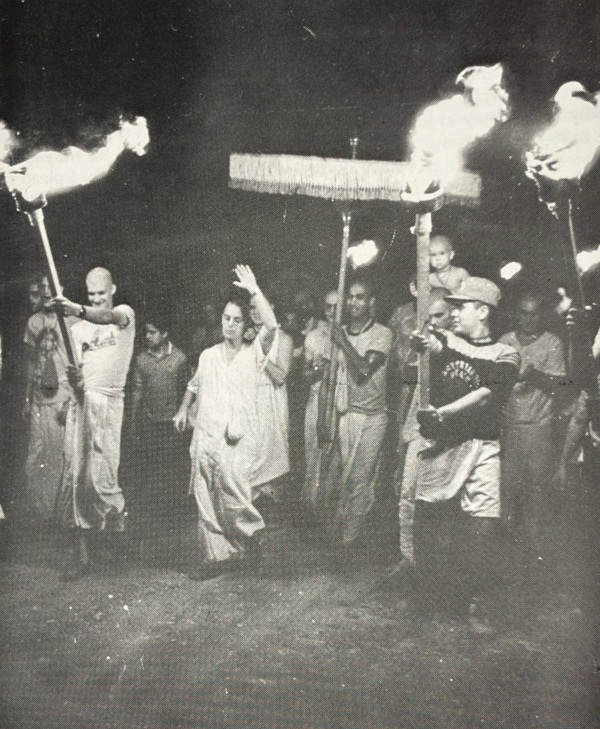
Photo from Bhaktipada’s Vyasa Puja book (September 5, 1988).
This photo was taken at New Vrindaban during a night time procession, but I don’t recall what was the event. Bhaktipada is center holding up his left arm, while Aniruddha (Andy Anzlin) on the left, and Lalita Madhava on the right, carry torches. Kuladri (Arthur Villa), the New Vrindaban temple president, carries his young son on his shoulders. I believe the photo was taken around 1986 or so. To see Frederick Difrancisco’s obituary, go to: Leaf Cremation Ohio. Curiously, his parents, wife and son are not mentioned in the obituary.

Photo from Leaf Cremation Ohio website (undated).
Endnote 7: This was Sri Galim/Gary Gardner, the headmaster of the boys’ school. He was not acquitted, but the charges were mysteriously dropped. As noted in Gold, Guns and God, Vol. 4:
On May 1st, 1987, three days before Sri Galim’s trial, District Attorney Tom White dropped the charges due to “technical flaws.” White said that legal research revealed that the original indictment contained technical errors and would probably not withstand an appellate review. White explained, “There is a problem with the indictment. . . . The case is dismissed, his bond is released and he is free to go.”
The boy’s mother, who had filed the charges, retorted, “There was plenty of evidence; we even had other gurukula boys lined up to testify. We were furious when the district attorney had the charges dropped. He had been paid off, probably by . . . Sri Galim’s father.”
Regarding the comment about Sri Galim butt-fucking students in front of the entire class, I believe this testimony is fabricated. Other boys said that Sri Galim, after the boys were asleep in their ashram, would drag his pet boy’s sleeping bag (and the boy in the sleeping bag) into his office and then he’d shut the door for privacy. In addition, Sri Galim personally told me he never sodomized any boy, although he admitted that he had performed other sexual acts.

New Nandagram headmaster Sri-Galim (Gary Gardner) with student.

New Nandagram headmaster Sri-Galim (Gary Gardner) with students.
Endnote 8.

This picture does not appear in the Hustler magazine, but I have included it here. Kirtanananda Swami samples his Sunday feast plate at Bahulaban, while his seven-year-old protégé, the first-born son of Hayagriva and Shama dasi, patiently waits for remnants (c. 1977). The shirtless devotee behind Kirtanananda is rendering devotional service by fanning the “pure devotee” with a peacock feather fan.
The boy’s mother, Cheryl Wheeler living in California, suspected that her son was being sexually molested at the isolated community, so she arrived there in March 1979 with a Marshall County Sheriff’s deputy and a court order to retrieve her son. She left empty-handed in tears, because the boy was hidden from her and spirited to his father in Mexico.
Samba, to my knowledge, has always denied that he was ever sexually molested as a boy at New Vrindaban. He said this in court in 1991, and he said it to me when he visited me at my home in Pittsburgh, Pennsylvania, I think in 2005 or so.
Endnote 9: This is a Freudian slip. The author meant to say Raghunath, who also lived at New Vrindaban, along with Radhanath and others. According to the Prabhupada Disciple Database, we think Raghunath dasa (Ralph Seward) was initiated in Los Angeles in 1971. There are four Raghunaths listed in the database. He taught at the Dallas gurukula, then moved to New Vrindaban.
He had great difficulty in controlling his sexual impulses. Bhagavatananda dasa beat him up once in the late 1970s, after Raghu tried to fondle Bhagavatananda’s wife’s breasts. The girls at New Vrindaban in the early and mid-80s regarded him as a pervert. Once he gave a girl a ride on his motorcycle. The girl sat in front of him, and she claimed he rubbed his erect penis on her backside during the ride.
My wife told me he had a fling with the first soprano of the New Vrindaban choir, while he was married to Sulochan’s divorced wife. Raghunath was finally removed from any official position at New Vrindaban in 2010 or 2011, due to the complaints of gurukula alumni. He still lives at New Vrindaban, I believe, with his wife, Jamuna devi dasi.

Raghunath with his wife Jamuna at New Vrindaban (undated, perhaps c. 2015)
Endnote 10: During a March 4, 1975 conversation with teachers at the Dallas, Texas gurukula, Bhaktivedanta Swami Prabhupada taught that teachers should slap a naughty boy on the face as punishment. Four months earlier, during a Bhagavad-gita lecture in Hyderabad, India (November 30, 1972), Prabhupada instructed, “Just like when . . . father always gives, always merciful to his son, but if the son is very obstinate, he gives him a slap.”

The teachers at New Vrindaban often slapped disobedient boys on the face. Once, the boys revolted and a riot ensued. Harivenu (Geraldo Altamirano), a gurukula alumnus, recalled:
All the boys were lined up outside in military formation. The teacher, Ananta [Andre Deslauriers from Montreal], was going down the line slapping each of us in the face. He was threatening us, “If you don’t straighten out, you’re not going to get to go to the festival at the Palace tomorrow; you’ll be stuck here at Wilson Valley while everyone else is having fun and eating the feast.”
The face slapping and beatings didn’t bother me too much anymore; I was a tough kid; strong body, built solid. But it upset me when I saw some of the skinny, less-hardy boys get slapped or beaten. Sometimes they’d cry. As I remember it, Manihar’s assistant, Niragadev, started slapping JC’s son, BT. I liked BT and I felt protective toward him. BT was deaf in one ear, so it was hard for him to hear. He would often cock his head and hold his hand over his good ear to hear better.
I couldn’t stand seeing him abused anymore, so I broke out of formation and stepped between BT and Niragadev. I threatened Niragadev. A fight started and it seemed like all the boys got involved. It really was a riot. We let out a lot of repressed and uncontrolled anger toward our teachers.

Endnote 11: In the 1970s and early 1980s, Kirtanananda Swami sometimes said at men’s darshans, “Three things improve with a good beating: your drum, your dog, and your wife.” I heard him speak these words with my own ears. On national television Bhaktipada said that sometimes it was okay for a husband to give his wife a slap on the face. Some, but not all, of the married men indeed beat their wives when they were unsubmissive. Some women came to mangal aroti with black eyes. They told their friends, “I got the mercy last night.”
Kirtanananda Swami learned this saying about beating women from his spiritual master, His Divine Grace A. C. Bhaktivedanta Swami Prabhupada! No where has it been said that Keith Ham was cruel to women until after he joined ISKCON. Where did Kirtanananda Swami hear this teaching about how to make women submissive? He got it straight from his spiritual master. During an April 12, 1969 tape-recorded conversation, Prabhupada said husbands should beat (and therefore tame) their unsubmissive wives. Many, many of Prabhupada’s male disciples heartily imbibed their master’s teachings about women, with very unfortunate results for ISKCON women.

“The husband beats, and she is tamed (laughter).”—Bhaktivedanta Swami Prabhupada
Endnote 12: One of my godbrothers at New Vrindaban told me, “Pavitra once said, ‘These young girls don’t know anything. It’s like having sex with your hand.”
Clearly, the young adult New Vrindaban husbands who were paired with child brides were totally unprepared, as were the unfortunate young brides. Training for a particular service was practically nonexistent in ISKCON. Neither the school teachers, nor the new husbands, nor the newly-wedded child brides received any training regarding their new service. Devotees were expected to learn by doing.
The young adult men who came to New Vrindaban and became brahmacharis were undoubtedly familiar with the courtship rituals of contemporary 1970s American society, but they had absolutely NO IDEA how to court a young teenage girl who had never dated a boy in her life, let alone had feelings or desires of a sexual nature. In his quote above which appeared in Endnote 3, when Bhaktivedanta Swami Prabhupada taught how to approach a child bride for sex, he cautioned his male disciples, “gradually, gradually.” This was something practically impossible for a lusty 20-year-old ISKCON brahmachari.
One of my younger godsisters spent much of her childhood at New Vrindaban, and at the age of 15 accepted a marriage to a 21-year-old Bhaktipada disciple brahmachari. She claims Radhanath Swami arranged the marriage, and asked her to marry the boy. Within a few days of their flower exchanging ceremony, the newly-wedded couple moved to New Vrindaban’s satellite center in Cincinnati, Ohio. The poor girl was used as a sex machine. She said her husband wanted to do it two, three, four times a day. She said she sometimes laid on the bed, crying from pain, but he could not or would not stop having intercourse with her. After a few weeks, she gathered the courage to speak to Radhanath Swami about her problems, and she said Radhanath Swami said he would speak to her husband.
But she claims, nothing changed. After all, Prabhupada said divorce was not permitted in Krishna consciousness. I do not know the details, but I heard she finally decided enough was enough, and rejected her husband and returned home. I am happy to report that thirteen years later, on August 4, 2000, my godsister married a mature devotee and the compatible couple have been together for more than two decades.
Endnote 13:
Bhaktivedanta Swami Prabhupada’s original instructions for the women at New Vrindaban were simple: caring for the children, cleaning, cooking and churning butter. He did not want the community modernized; he wanted New Vrindaban to be like the ancient Bronze-Age Vrindaban India, when women were not allowed to have independence. At that time in history, women had rigid roles to follow and most devotees believed that that is what Prabhupada wanted to create at New Vrindaban and his other ISKCON farm communities.
During the Vedic Era, girls were not allowed to go to school. In fact, even boys born in low-class families, such as Vaishya or Sudra boys, were also not allowed to go to school and learn to read and write. Only boys born in Brahmin and Ksatriya families were permitted to attend school. In ancient India, most children, at an early age, went out picking crops in the field, or digging in the mines alongside their parents. Bhaktivedanta Swami Prabhupada did not think it important that girls learn to read or write, or go to school. He felt they could learn whatever they needed to know about their life’s purpose—serving their future husbands—by watching their mothers at home. In ISKCON, the boys learned to read and write, but that was not always the case for girls.
Bhaktivedanta Swami Prabhupada instructed the women at New Vrindaban, “I have advised Kirtanananda Maharaja that girls who are living in New Vrindaban should be engaged in the following activities; (1) taking care of the children, (2) cleaning the temple, kitchen, etc., (3) cooking, and (4) churning butter.”—Bhaktivedanta Swami Prabhupada, letter to Labangalatika d.d (Rosalie Haswell Borthwick) (June 24, 1969).

“Churning butter will keep the women fit and healthy with slim figures.”
Bhaktivedanta Swami Prabhupada based his ideas about women to a large extent on the Manu-samhita, a discourse given by Manu, the progenitor of mankind, to a group of seers who beseeched him to tell them the “law of all the social classes.” The Manu-samhita is the basis for the Indian caste system. Manu decreed the place of women in society, “Day and night, men should never give any freedom to women. By engaging them in proper activities they should keep them under their control. The father protects her in childhood, the husband in youth, the sons in old age. A woman does not deserve independence.”—Manu-samhita, 9.2-3.
For more about the children of ISKCON, see Gold, Guns and God, Vol. 4: Deviations in the Dhama.
| Back to: Gold, Guns and God, Vol. 4 |