My Life on “The Pick”

A Memoir by Henry Doktorski

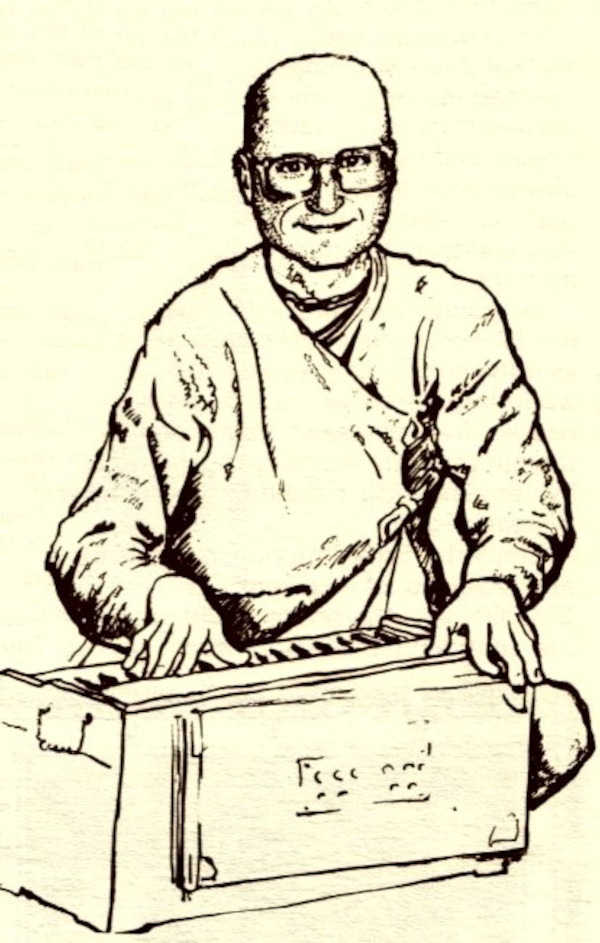
Hrishikesh dasa plays harmonium in the Bahulaban Temple.

Drawing by Krishna Katha (Carl Carlson) published in the February 1982 issue of Brijabasi Spirit.

Part One: Introduction
Part Two: Helping to Raise Money for Krishna
Part Three: After much austerity, finally success on “The Pick.”
Part Four: Some pickers I have known.
Part Five: I Lose My Mojo.
Part Six: The End of My Picking Career.


Part One: Introduction

I served my spiritual master, the ISKCON-approved guru His Divine Grace Kirtanananda Swami Bhaktipada, out on “The Pick” full-time from October 1979 (with a two-month break from January to March 1980 when I served as Temple President of ISKCON Pittsburgh) until September 1985, and then part full-time and part part-time at least until 1988. “The Pick” is devotee jargon for fundraising out in shopping center, sports stadium and rock concert arena parking lots, and other places, to collect Laksmi (the Goddess of Fortune commonly known as “money”).

At first I was highly unsuccessful at this trade. Approaching strangers and trying to coax them to give me a dollar or two for charity was incredibly difficult for me. I felt I was a failure. But after a year or two, I discovered the secret to collecting big, and began collecting $1,000 per week. Then $2,000, then $3,000 per week. One year (I think 1984) I got 30,000 people to give me a $5.00 donation. I raised $150,000 for New Vrindaban that year. My total contribution towards the New Vrindaban coffer could have been $500,000. Perhaps more.

I was known as a maharathi, a Sanskrit word for a great warrior. My picking partner dubbed me “The Professor,” and a few years later, Devamrita Swami, the New Vrindaban temple president and sankirtan leader, started calling me “The Prince of the Pick.”

We pickers were respected as warriors for Krishna, rescuing Laksmi from the evil (or at least ignorant) karmis (non-devotees) to reunite with her Lord, Master and Husband, Vishnu, where she belongs. I mostly enjoyed my service. It was exciting at times, often austere, sometimes painful, but it had its own pleasures and perks, which I will attempt to describe in this essay.

Henry becomes Hrishikesh dasa

Perhaps some background information is in order. I lived at the New Vrindaban Hare Krishna community from August 1978 until April 1994. When I joined the community I had just received three months earlier a Bachelor of Arts degree in music. I had studied music for most of my life. In 1963, as a seven-year-old child, I showed some musical talent so my parents enrolled me in the studio of one local New Jersey accordion teacher.

In high school I discovered classical music after joining the school choir. Shortly after, I began serious piano studies and later was awarded a scholarship as a piano major at a small Midwestern liberal arts college. There, along with music, I developed a keen interest in Indian spirituality and the counterculture. I grew my hair long; I heard the former Harvard University Professor-turned-yogi, Baba Ram Dass, lecture at the University of Kansas; I was initiated into Transcendental Meditation for a $35 fee and silently chanted my secret mantra twice a day; I decided to become a vegetarian and even told my piano professor, much to his chagrin, that after finishing graduate school I would join a spiritual commune somewhere and devote my life to the search for the Absolute Truth. I acquired a packet of LSD from a friend and kept it in the kitchen freezer, intending to expand my consciousness, but never used it because I feared, as a pianist, that it might ruin my music career if I had a “flashback” during a concert performance and I lost my motor control and coordination.
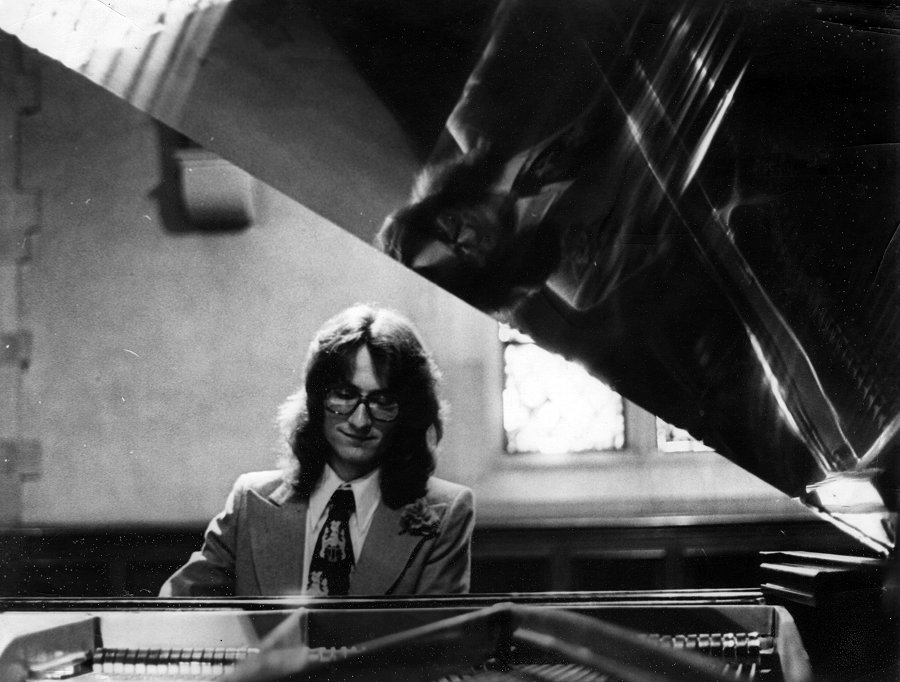
Senior Piano Recital, Park College, Parkville Missouri (April 16, 1978).

After graduating from college in May 1978, I briefly visited the Maharishi University in Fairfield, Iowa, to check out the scene, but was sorely disappointed; the students there dressed in conservative shirts and ties and wore short hair cuts. I thought they looked a little like fundamentalist Christians. I was looking for something more radical; something less mainstream; something more austere. By chance or by the design of a higher power, on the way home from Kansas City to New Jersey in July 1978, I visited a former high school buddy who that year happened to have a summer job in Wheeling, West Virginia. While sitting in his barren, hot and stuffy apartment with nothing to do, he suggested, “Why don’t we visit the nearby Hare Krishna community; they’re building a palace for their founder. I’ve been there before; it’s really cool!”

We spent the afternoon touring New Vrindaban and I was impressed. I found a community of spiritual seekers who seemed to practice what they preached: renunciation. The single men slept for only six hours each night in sleeping bags on the floor of an ashram with twenty or thirty others; they took ice cold baths (there was no hot water)—without even using soap (as far as I could see)—in the communal bath house. The toilets were only holes in the concrete floor (Indian style) without even doors on the front of the stalls! [Endnote 1]

The New Vrindaban devotees chanted Sanskrit mantras for two hours daily, usually attended two temple services daily (and sometimes three on Sundays), worked at least eight hours daily for Krishna without remuneration, ate only vegetarian food offered to Krishna, and spoke nothing except topics about Krishna or Krishna’s service.

One of the devotees remained perpetually silent except for the words “Hare Krishna” which he would sometimes unexpectedly and loudly shout. [Endnote 2] Another devotee stubbornly refused to wear socks or shoes, even in winter. His feet were heavily calloused and pitted with deep cracks which reminded me of the canals on the surface of Mars. [Endnote 3] These people obviously were serious about minimizing bodily needs. They were tough; like the Marines. Hare Krishna seemed to me to be the elite “Green Berets” of all the Indian spiritual movements. And the philosophy appeared undefeatable. This is what I wanted: a challenge.

About a month later, I visited the community again during a drive out West and met Kirtanananda Swami for the first time. I was immediately drawn to the warmth and kindness which seemed to radiate from him. He appeared to express genuine concern for me and I listened to him speak as a respectful son listens to a wise and compassionate father. During our first conversation he convinced me (not an easy task) to set aside my music studies and join the commune as a full time devotee to develop my spiritual life.

As I had sacrificed a great deal (a potentially promising career in music) to live at New Vrindaban, I decided to give the process a fair chance: I faithfully chanted sixteen rounds daily, strictly followed the four regulative principles, scrupulously attended all the required spiritual programs, resided with similarly-minded godbrothers at the remote Old Vrindaban brahmachari (celibate male student) ashram, and worked to the best of my abilities to help build a ornate memorial shrine for the late founder and acharya of the International Society for Krishna Consciousness: A. C. Bhaktivedanta Swami Prabhupada (1896-1977) who had passed away only nine months earlier.

Going “cold turkey.”

My first months at New Vrindaban were incredibly difficult, due in large part to withdrawal from the object of my affections: classical music. During college I had performed with symphony orchestras, sang Handel’s Messiah with a huge 280-voice choir, and even performed a leading role in a concert performance of Puccini’s opera Madame Butterfly. I had composed original music for musical theater productions and directed pit orchestras. But that was all over now. Finis.

From hearing Bhagavad-gita and Srimad-bhagavatam classes I technically understood that most music was simply sense gratification: a highly pleasurable activity which distracted the soul from God and entrapped the living entity in Maya’s illusory energy. But God! how difficult it was for me to shed my addiction to classical music! My intellect insisted that I should stay at New Vrindaban, shed my material desires and develop my dormant love for God, but my heart sorely missed the thrill of composing, performing and listening to classical music; the excitement, the glamour, the acclaim, the intellectual satisfaction and the rapturous beauty of the passionate melodies, harmonies and rhythms which had captivated my consciousness for so many years.

Building Prabhupada a palace.

I clearly remember working at Prabhupada’s Palace-under-construction, probably in October 1978, doing some solitary gold leafing in the central kirtan hall, crying out in despair from the pain of my mental and emotional anguish and mournfully singing in a loud voice the mahamantra (great chant for deliverance): “Hare Krishna, Hare Krishna, Krishna Krishna, Hare Hare; Hare Rama, Hare Rama, Rama Rama, Hare Hare” to the tune of the plaintive Jaya Radha Madhava melody which was sung every morning before the daily Bhagavatam class. I put my entire heart and soul into that chanting; I was suffering so much. I begged Krishna, “Please help me! Please save me! Tear out my material desires from my tortured heart and heal it with unconditional ecstatic love for you!”
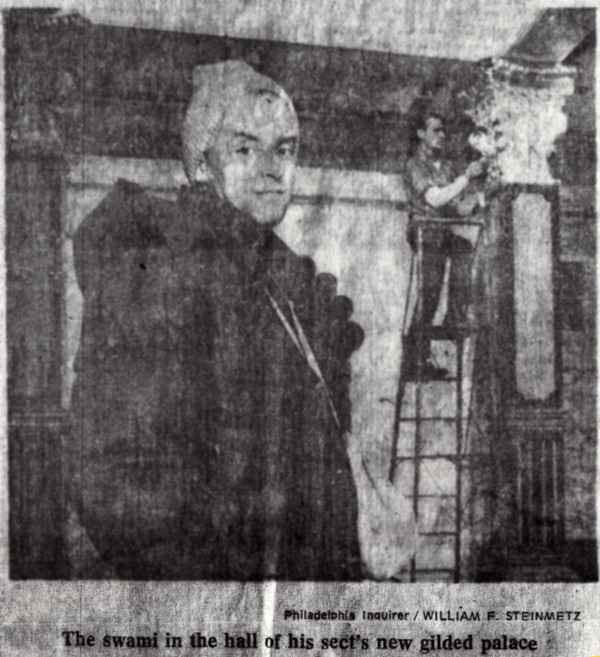
Kirtanananda Swami at Prabhupada’s Palace-under-construction. The author appears in the background applying gold leaf to a Palace Kirtan Hall column capital (Philadelphia Inquirer photo, c. October 1978)

Sometime shortly after, apparently by the grace of guru and Krishna, I acquired a taste for devotional service—seemingly overnight—and my mental tempest dissipated like the thick New Vrindaban early-morning fog which is burned off by the rising sun. I requested initiation from Kirtanananda Maharaja: “I would like to become your disciple and spend the rest of my life serving Krishna here at New Vrindaban.” Maharaja beamed joyfully and exclaimed, “Jaya! That’s what I like: someone who comes and does not run away.” (“Jaya” or “Jai” is a Sanskrit exclamation designating approval, often translated as “victory.”) I was initiated on March 13th (Gaura Purnima), 1979, and received the name Hrishikesh dasa (servant of Krishna, who is the master of the senses).

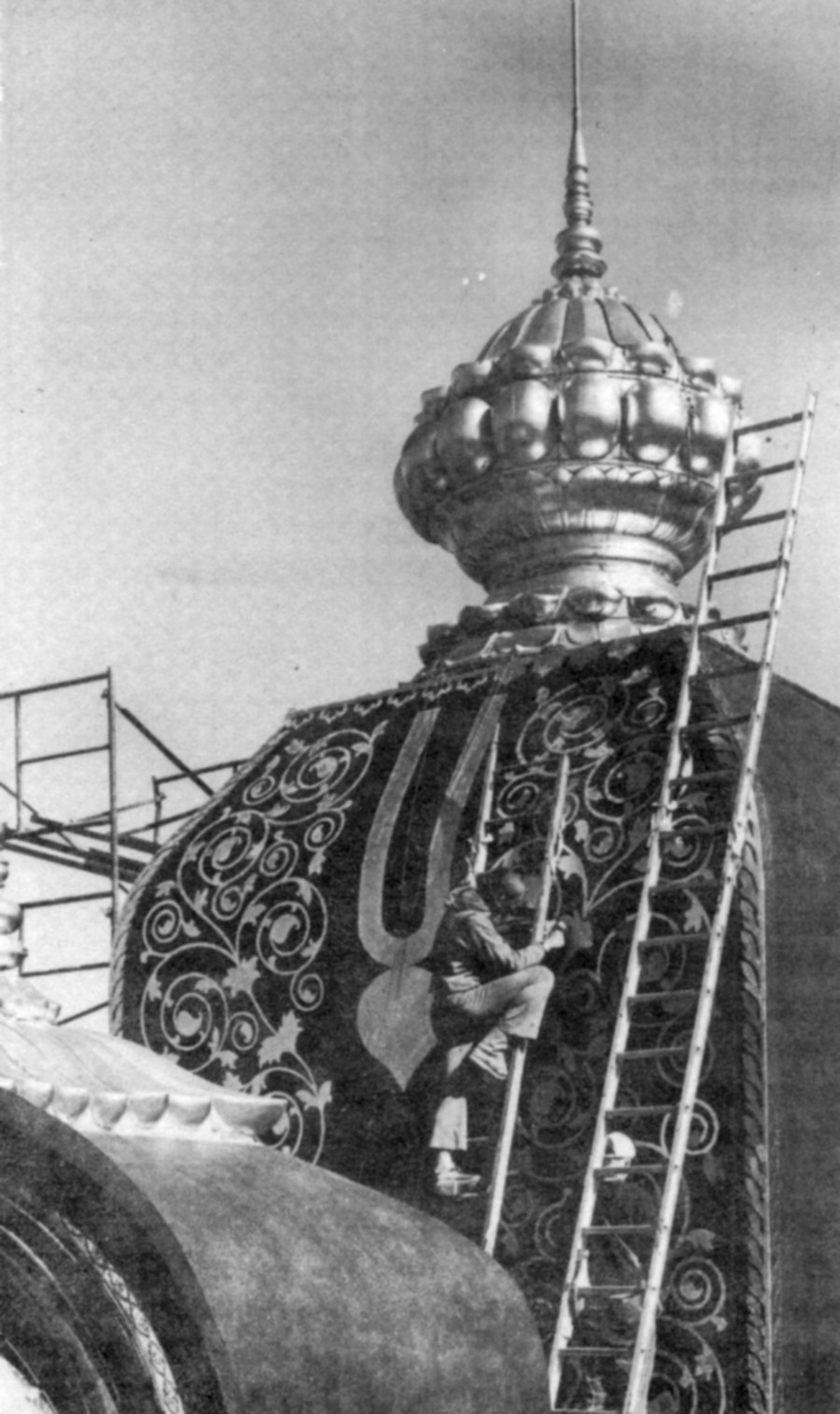
The author working on the Palace dome

The author applies gold leaf to the Palace dome (Summer 1979)

“The Pick.”

In October 1979 I worked a big event in Chicago, “The Pope Pick,” and excelled at selling buttons with the image of Pope John Paul II. This was my first time collecting money for New Vrindaban, and I was, amazingly, the top men’s collector at the event. Thereafter I was sent to the ISKCON temple in Cleveland, Ohio, to learn how to distribute Prabhupada’s books. At first I was terrible. But I doggedly continued in this service, as my spiritual master said Sankirtan is the highest service.

Somehow or other, after about six months, I suddenly discovered how to do this service of collecting money, and a couple years later, in 1981, I won an award for being the top men’s collector for 1981. I enjoyed the praise I received from my spiritual master, my godbrothers and the other New Vrindaban residents.

I excelled at this service of “picking” for perhaps five years, but, beginning in 1984, I began to develop some physical weaknesses which greatly reduced my stamina and collections. I was unable to regularly do big on “The Pick” anymore because my body had lost much strength, I believe, partly from the stress of the service itself as well as our customary abuse of and disregard for the body’s needs. Now I will tell the story about my life on The Pick.


Part Two: Helping to Raise Money for Krishna.

The Candle Factory.

The once-profitable New Vrindaban Spiritual Sky incense business—which funded the purchase of properties such as Madhuban, Bahulaban and Guruban—folded during the mid-1970s, and the income from drug smuggling and dealing—which funded much of the construction supplies for Prabhupada’s Palace—ended soon after the September 1979 Palace dedication. (For more about unconventional sources of funding for New Vrindaban, see the author’s books, Gold, Guns and God, Vols. 2 and 3.) A new source of funding was needed.

Candles were a big money maker in 1978 and 1979. New Vrindaban established a candle factory at Bahulaban where residents dipped and carved elaborate and colorful decorative candles which sankirtan devotees sold in malls or on the road. Beginning in September 1978, I worked up at the Palace-under-construction, mostly gold leafing the interior and exterior. In October, I began painting the perimeter ceiling of the Kirtan Hall, a project I finally finished in March 1979. But around December 3, 1978, I was assigned to work for a few weeks in the New Vrindaban “Candle Factory” at Bahulaban. My service was dipping candles in 55-gallon barrels of molten wax.

As I recall, we began with a plain, generic commercial candle, purchased cheaply in bulk. The candle factory workers dipped the candle a dozen times in one barrel of colored wax to thicken the candle, then we’d take the candle over to another barrel with wax of a different color, and dip into the new barrel. We continued this process maybe a half dozen times, then passed the bulk candle over to the candle carvers, who sat at tables with sharp knives. These carvers sliced the soft, warm wax and folded the slices to create fantastical patterns with bright kaleidoscopic colors.

An ornamental candle similar to those manufactured at New Vrindaban.

When the carvers finished a candle, it was then passed to the packers, who placed each candle in a corrugated cardboard box with dividers, so the candles would not get damaged during transport. Finally, the traveling sankirtan devotees picked up boxes of candles when they visited New Vrindaban, and then went back out on the road to sell the hand-made New Vrindaban product. Candles were a big seller during the Christmas season, as shoppers often look for unique and exciting gifts for family and friends.

In 1980 as I recall, the Candle Factory moved up to the Palace. It was located in the rooms behind the Palace which were in future to become the Palace Restaurant and Gift Store. Unfortunately, during the winter of 1980, the Candle Factory burned to the ground. The flames shot a hundred feet into the air as thousands of gallons of wax blazed. Even the specially-ordered incredibly-long steel-reinforced concrete beams which supported the roof (which cost many tens of thousands of dollars and were shipped in by dozens of specially-trained tractor-trailer semi-truck drivers) were destroyed. The devastation was complete. A new source of income was needed, and traveling sankirtan evolved to fill the void. Soon New Vrindaban pickers would generate millions of dollars in income per year. But back to the winter of 1978.

During the 1978 Christmas marathon I dipped candles in huge barrels of colored molten wax at the Bahulaban candle factory. When the Christmas marathon was over, and the sankirtan devotees returned to the farm, I returned to my service of painting the perimeter of the ceiling of the Kirtan Hall at Prabhupada’s Palace-under-construction.

The six-month Palace Marathon, from March to September 1979 was intense. I will tell some stories from that time later. The Palace Dedication Festival during Labor Day Weekend 1979 was a grand and blessed event which I will also describe at another time.

The author plays harmonium during kirtan at one of the Palace festivals (c. early 1980s). Jalakolahali plays mrdanga drum and an unidentified black devotee plays tamboura, while Dayavira chants on his beads.

After the Palace Dedication Festival , I began serving as a teacher at the Nandagram Boys School. I taught music there for about a month. I lived at the Vrindaban Brahmachari Ashram, and walked across the ridge to the Nandagram school, about a mile distant. Every day I returned to the Vrindaban Farm. I enjoyed teaching the boys. I had no discipline problems. I think they respected me, and I was fair to them.


The Pope Pick.

On October 5, 1979, I worked the “Pope Pick” at Grant Park on the shore of Lake Michigan in Chicago, Illinois. New Vrindaban sent out dozens of collectors in vans to Des Moines, Chicago, Philadelphia, Washington D. C., New York City and Boston—the cities on the pope’s first United States tour—to hawk buttons and other paraphernalia displaying a photo or image of Pope John Paul II to the massive crowds who came to attend Mass presided by the pope. Tens, if not a hundred thousand dollars were raised for New Vrindaban to help complete Prabhupada’s Palace of Gold, which had been dedicated only one month earlier.

Pope John Paul II was born Karol Józef Wojtyła in Wadowice, Poland in 1920. He rose through the ranks of the Roman Catholic hierarchy, becoming a priest, a bishop, the Archbishop of Kraków and then a cardinal. He was elected pope in October 1978, becoming one of the youngest popes in history. John Paul II was pope for nearly 27 years, until his death in 2005. Nine years later, he was officially canonized as a saint by the Catholic Church. He was the favorite pope in my family, as we are both Roman Catholic and Polish.

John Paul II in Chicago.

The Pope Pick was my first time ever collecting money for New Vrindaban. As noted earlier in this essay, during my first year at New Vrindaban I helped build Prabhupada’s Palace, and after the Palace dedication on September 2nd I served as a music teacher for the boys at Nandagram School for a month. Now, I looked forward to the exciting experience of collecting money for Krishna. I rode in the back of a van with a bunch of others from New Vrindaban to Chicago the previous evening (October 4th). We slept in sleeping bags on the crowded floor of the van.

As I recall, after an eight-hour drive, we arrived at Grant Park in Chicago early in the morning. Dharmatma dasa (Dennis Gorrick) was there with his own van to coordinate the New Vrindaban pickers. He provided us with shoulder bags containing hundreds of pope buttons. Some other pickers had bars of soap carved in the likeness of John Paul II, which people could hang up in their shower stall. We called the item “Pope on a Rope.”

Around 8 a.m., the crowd started pouring in, and we began picking, offering our buttons for sale. As I recall, we asked $2 per button. The buttons cost maybe twenty-five cents, if that. We were vendors hawking our wares: “Get your Pope buttons here! Pope buttons, only two dollars!” People in the crowd raised their hands, indicating that they wanted a button, and we’d move through the crowd, passing out buttons and collecting money. Some people bought four or five buttons. Some bought ten. Many, many times, I ran out of buttons and ran back to Dharmatma’s van, turning in my Laksmi and grabbing another shoulder bag filled with buttons.

A button with Pope John Paul II’s image.

I discovered that the best way to make money was to find a fresh crowd; people who hadn’t yet seen the buttons. After we’d been picking for four or five or six hours, it was not easy finding a fresh crowd, but somehow I managed to find them.

The climax of the day was an afternoon open-air Mass at the Petrillo Band Shell at Grant Park. At 3 p.m., church bells rang throughout the archdiocese, signaling the entrance procession for the Mass that was celebrated by the Holy Father and 350 bishops from all over North America. An estimated 1.2 million people gathered in the park for the two-hour-long Mass. The weather remained sunny and seasonable.

The pope was a half an hour late, and by the time he arrived, more than 1 million people had amassed in the 319-acre park. John Paul II gave Holy Eucharist to 150 people chosen from the six Vicariates of the Chicago Archdiocese, while more than 600 priests and deacons administered the Eucharist to the full crowd.

During Mass, naturally as a respectful Catholic boy, I did not hawk my buttons loudly. If I did, the people would have hated me for disturbing their Holy Mass. But I did walk quietly through the crowd waving over my head a button in one hand, and with my other hand, displayed two fingers which indicated the number “two dollars.” I still made some sales in this way.

The crowd was estimated to be 1.2 million.

After the Mass, many in the crowd chanted “John Paul Two, We Love You!” The pope responded with “John Paul Two, He Loves You!”

When the Mass ended, around 5 or 6 p. m., the crowds began dispersing. Of course it took several hours for 1.2 million people to get back to the taxi stands, bus stops, subway stations, and their parked cars. I found a good spot where many thousands of people had to pass and hawked my buttons again, this time only for $1. “Last chance to get your Pope buttons! Only one dollar!” I think after a while I dropped the price to “Two for a dollar!”

The sun set in Chicago that day at 6:30 p. m., but we kept working, as the crowd still numbered in the thousands. Finally around 10 or 11 p. m., everyone had left, except for a handful of park maintenance employees and us New Vrindaban devotees. Dharmatma’s helpers were counting the Laksmi scores.

I was quite surprised when Dharmatma announced, “Hrishikesh is the biggest collector of the day, with 1,643 Laksmi points!” In sixteen hours, I averaged more than $100 per hour. I even beat New Vrindaban’s biggest picker on the men’s parties: Muktakesh dasa (Ronald Burstein) by a mere $20.

Muktakesh was a big book distributor and a big picker for the last five years for Buffalo ISKCON and New Vrindaban. But now his big ego was bruised. He was so pissed he had been beaten by a rookie, and he told me so to my face, that he grabbed some buttons and ran out into the night in a futile attempt to make 21 more dollars and retain his title. He returned fifteen minutes later, disappointed, and he reluctantly admitted that I had taken away his crown.

After this, my days on “The Farm” were numbered. In a few months, I would become a full time “Picker,” a position I maintained and (mostly) enjoyed for about seven years.

Muktakesh dasa, ACBSP (Ronald Burstein) (1947-2007).


Trying to sell Prabhupada’s books in Cleveland.

On or around October 7, 1979, perhaps only a couple days after the Pope Pick, New Vrindaban authorities shipped me to the Cleveland, Ohio ISKCON temple, the New Vrindaban satellite center at 15720 Euclid Avenue in the East Cleveland ghetto. The temple president, as I recall, was Sundarakar dasa Adhikari ACBSP (Steven Fitzpatrick). The deities on the altar were Radha Muralidhara. Janakanath dasa ACBSP (Anthony Gierz) served as pujari and cook.

Tapahpunja dasa Brahmachari ACBSP (Terry Sheldon) was the resident sankirtan expert, and he attempted to train me up how to distribute Bhaktivedanta Swami Prabhupada’s books, like the small paperback Easy Journey to Other Planets, in the parking lots of Kmart department stores and Kroger supermarkets in various small towns in North Eastern Ohio.

Tapahpunja Swami (Terry Sheldon)

Just a few days earlier, on October 5th, I proved my prowess as a collector at the Pope Pick in Chicago, my first ever sankirtan event, where I collected $1,643 by selling buttons displaying the image of Pope John Paul II. New Vrindaban authorities suspected I might be able to learn to collect big on regular sankirtan in the parking lots of Ohio shopping malls and rock concert stadiums, but I proved myself a failure. I was terrible. I could hardly get a donation, let alone sell a book. This service was incredibly difficult for me. In fact, it was frightening.

It was one thing to sell a button which everyone wanted; and an entirely different thing to sell a book (with an image on the cover of an emaciated yogi) which no one wanted. Not to mention the police officers and security guards who constantly told me to move on or get arrested, as Tapahpunja never bothered to apply for a solicitor’s permit.

The cover of Easy Journey to Other Planets by Bhaktivedanta Swami Prabhupada.


My first rock concert, and first arrest.

On October 27, 1979, the American rock band, the Eagles, performed the first of a two-night sold-out stand at the Richfield Coliseum—a 20,000-seat indoor arena between Cleveland and Akron, Ohio. This was the first leg of the Eagles’ “The Long Run” tour. I was there before the concert in the parking lot, trying (without much success) to get donations for Bhaktivedanta Swami Prabhupada’s paperback book, Easy Journey to Other Planets.

The Eagles

After a short time a security guard questioned me, then asked me to come with him to the security office where I was charged with trespassing. My mentor, Tapahpunja, bailed me out and asked me what happened. I said a security guard stopped me and asked me if I was going to the concert. I said, “No. I’m just here to distribute books.” Then the security guard arrested me for trespassing.

Tapahpunja rebuked me, “You fool! You should have said that you were going to the concert! Then he would have simply told you to stop distributing books, and you wouldn’t have been arrested!” Tapahpunja conveniently forgot the fact that he had not given me any prior instruction on what to tell the security guards if I was questioned. How could I possibly know what to say?

I felt bad after his chastisement, but the pained look on my face must have touched Tapahpunja’s heart, for then he encouraged me, “That’s all right. You are a brahmin, and a brahmin is always truthful.”

Richfield Coliseum


My first taste of traveling sankirtan.

On or around November 7, 1979, while stationed at the Cleveland ISKCON temple, my mentor, Tapahpunja dasa Brahmachari, took me out on traveling sankirtan for an entire week, my first time on the road.

Terry Ray Sheldon was born November 2, 1948 in a “poor, working-class neighborhood” in Detroit, Michigan. He joined ISKCON at the Detroit temple, and after a few months, moved to New Vrindaban. He received diksa and the name Tapahpunja in October 1974. He admired Kirtanananda Swami and developed a strong emotional attachment for his siksa guru. For a few years he served Bhaktipada in Buffalo, New York and Columbus, Ohio. Both were New Vrindaban satellite centers.

Tapahpunja exhibited his leadership abilities by becoming an expert sankirtan “Picker” and party leader, renowned for his ability to avoid detection by the police. He also served as the New Vrindaban men’s sankirtan leader (1979-1980). Some affectionately called him “Mr. Scam Kirtan.” Tapahpunja was intelligent and personable. Dharmatma remembered him, “He was very innovative. He was quite intelligent in regards to putting things together.”

In November 1979, Tapahpunja and I left Cleveland ISKCON in a beat-up old van with a couple cases of Prabhupada’s book, Easy Journey to Other Planets. Tapahpunja drove south towards Akron where we worked the parking lots of Kroger supermarkets and Kmart department stores. Although this was extremely difficult work for me—trying to get a donation from a housewife on a budget for a book with a picture of an emaciated yogi on the cover—I trudged along and gave it my best, as I was told this service was extremely pleasing to Krishna.

One time we coincidentally met another New Vrindaban traveling sankirtan party: my godbrothers Damodar (Allen White) and Jagannath Mishra (James Bulsa). Those two guys took to the pick like ducks to water. When we arrived at a supermarket parking lot, Damodar and Mish jumped out of the van like paratroopers jumping out of a military airplane going to battle to rescue Laksmi from the karmis. I, on the other hand, was petrified and I sat in the van chanting my rounds.

After a few hours, after the store manager came out and told us to leave, Tapahpunja drove us to another parking lot in another part of town. Late in the day, we stopped distributing books and drove to a Kmart parking lot where we spent the night sleeping in our sleeping bags on the floor of the van. But first we used a small propane camp stove to heat up a quart of milk in a steel pot, which we drank before spreading our sleeping bags on the floor of the van and taking rest.

Kmart parking lots were good places to park overnight, as there were usually a half-dozen or more other vehicles parked overnight and we wouldn’t draw any attention to ourselves. Truck stop parking lots were also a good place to spend the night. If we parked at other locations during the night, sometimes the police would wake us up and tell us to move on.

In the morning, Tapahpunja drove our van to a partly-seclude place, such as against a brick wall, where we opened the side doors of the van, stripped to our kaupins (a one-piece loin cloth underwear common in India) and bathed using a gallon of water in an old plastic milk jug. We had filled the jugs with water the previous day at a gas station. First Tapahpunja bathed, to show me how to do it.

Bathing is very important to Krishna devotees. At New Vrindaban we take a cold shower every morning before dressing in a clean dhoti and kurta to attend the morning program at the temple. Tapahpunja demonstrated: first he poured a couple cups of water on his shaved head, and let the water flow down his body. Then he grabbed a bar of soap, and lathered himself. He untied his loincloth in the rear, and washed out his kaupins, while the cloth still covered the front of his body, as devotees are taught to be modest (never nude).

Then Tapahpunja poured the remainder of the gallon of water on his head and rinsed off all the soap. When the jug was empty, he dried himself with an Indian towel, changed into a fresh kaupin, and got dressed in his karmi clothes. I followed suit. I found this life of the traveling picker quite pleasant, as I am an Eagle Scout and I love camping out in the woods. However, camping in a Kmart parking lot is not as romantic as camping in the woods, but I think you get the idea.

After we freshened up, Tapahpunja put up a picture of Radha Vrindaban Chandra, the presiding deities of New Vrindaban, on the dashboard, and we chanted our sixteen rounds, which took about two hours. If the outside temperature was uncomfortably cold, we chanted inside our van, but most of the time we went outside and chanted while slowly pacing back and forth. Often Tapahpunja drove to a nearby park which was quiet and beautiful; a peaceful place to chant our rounds.

My personal photograph of the presiding deities of New Vrindaban: Radha-Vrindaban Chandra, on their altar at Bahulaban.

After our rounds were completed, we had a short Morning Program, chanting the Samsara Prayers, Prayers to Lord Nrsimhadeva, and the Jaya Radha Madhava Prayers, using a small pair of kartals (brass cymbals) for musical accompaniment. Tapahpunja then read a verse from Srimad-Bhagavatam and spoke a bit about the verse.

We had our own little kitchen in the van, with a cutting board, knives and serving spoons, and a Coleman propane camp stove. Tapahpunja chopped up the vegetables, and prepared a pot of kitchari. Every day we cooked and ate the same dish: kitchari (the word means “mixture” in Hindi), a traditional Indian dish typically made with mung dal (split mung beans) and white basmati rice, flavored with herbs and spices (we used cumin seeds, dried chili peppers, turmeric powder, diced ginger root and asafoetida powder fried in ghee), and cooked with various vegetables. Some say that kitchari is the ultimate comfort food.

Asafoetida powder (hing) is made from the dried latex (gum) exuded from the tap root of several species of perennial herbs from the carrot family. Turmeric powder, made from the dried rhizomes of a plant in the ginger family, has a warm, bitter, black pepper-like flavor and earthy, mustard-like aroma. It is often used in Ayurvedic medicine.

Where did we get our vegetables? Tapahpunja liked to save Krishna’s money (we were taught not to spend money on ourselves) so instead of purchasing vegetables at the supermarket, each morning we drove our van behind the supermarket where Tapahpunja went “Dumpster Diving,” to search for vegetables which were discarded by the produce managers, as the vegetables were beginning to wilt and were unsellable. In a minute or two Tapahpunja would return to the van with an armload of wilted, but still edible produce. Dumpster diving was lots of fun. Occasionally, when we were unable to find a public restroom, we’d do our duty (morning duties we called it, passing stool) in the dumpster.

A bowl of kitchari.

After breakfast, around 11 a. m., we hit the parking lots in a courageous attempt to distribute Prabhupada’s paperback book, Easy Journey to Other Planets. Tapahpunja appeared to enjoy walking up to people, getting their attention, conversing with them, showing them the book, and asking for a donation. I did not. I’m not a shy person, but it was very difficult for me to approach all these people and get rejected dozens, if not hundreds of times a day. Sometimes I’d just sit in the van and chant on my beads, too “fried” from working the parking lots without success.

Once in a while in the morning while preparing a pot of kitchari, Tapahpunja would take a cup or two of wheat flour, add water, roll the dough into cylinder shapes about 6 inches in length, and deep-fry them in a pot of hot ghee. I thought these breadsticks were delicious, and around 4 or 5 p. m., we’d take a break and snack on the bread sticks.

On Sunday, for an afternoon dessert treat, we’d split a 48-ounce container of Breyers ice cream. Tapahpunja said that Breyers was the best brand. Eating such prodigious amounts of ice cream gave us nasty flatulence a few hours later, but it was well worth it; a real creamy and sugary treat. Eating ice cream was usually the high point of my week. We rarely got to eat such rich food at New Vrindaban, except during the weekly Sunday feast.

Then we hit the parking lots again until sunset. Before bed, we drank a glass of hot milk.

A 48-oz. container of Breyers ice cream.

During this week of distributing Prabhupada’s books on traveling sankirtan, we passed through Eastern and Southern Ohio, visiting small towns along the Ohio River and working the supermarket parking lots. We eventually landed in Louisville, Kentucky, about 300 miles from Cleveland.

Tapahpunja told me Bhaktivedanta Swami Prabhupada predicted World War III was coming soon, and because Prabhupada knew Krishna, he knew everything: past, present and future. Tapahpunja played for me a cassette tape during which Prabhupada claimed, “Your country, America, is very much eager to kill these Communists. And the Communists are also very eager. So very soon there will be war. . . . Preaching will be very nice after the war when both of them, especially Russia, will be finished.” [Endnote 4]

Tapahpunja was dedicated to Bhaktipada’s mission and he believed New Vrindaban would become the saving grace of civilization when the nuclear bombs started falling from the sky. This, he claimed, would destroy human society as we know it. During such a nuclear winter, the government would break down and anarchy would prevail. In such a catastrophic scenario, he believed, hundreds of thousands of displaced people would take shelter at ISKCON farm communities, such as New Vrindaban, where the economy was (in theory, at least) based on land and cows.

Every day Tapahpunja studied the Rand McNally road atlas to note our position in relation to the Ohio River. “In the event of a nuclear war,” Tapahpunja told me, “the best way to get back to New Vrindaban would be to follow the Ohio River upstream to Moundsville, and then cut across country by foot.” After a week or so on the road, we turned back and returned to Cleveland ISKCON. I never imagined at the time that I’d be living out of a van for the next five or six years.

Simulation of an atomic bomb explosion.


My second rock concert, and second arrest.

On December 2, 1979, the British rock band “The Who” performed at Pittsburgh’s iconic Civic Arena, the world’s first retractable-roof major sports/concert arena. Barry Paris, a Pittsburgh Post-Gazette reviewer, declared it the “best show of the year.”

The Who in concert (undated)

New Vrindaban naturally sent a contingent of sankirtan devotees, including myself (at the time a rookie), to sell books and collect donations from concert attendees. We worked the parking lots and sidewalks. Some of the Dharmettes snuck inside the massive domed structure and worked the aisles and hallways inside.

Pittsburgh Civic Arena

After a relatively short time, I found myself behind bars with about a dozen other devotees in a stone building which resembled a Medieval fortress: the Allegheny County Jail. I believe we were charged with trespassing. We chanted kirtan behind bars in the holding cell for a couple hours until we were processed and released.

Allegheny County Jail

We all considered our treatment by the police a blatant crime against Sanatan Dharma, the eternal religion. Senior devotees told me that Bhaktivedanta Swami Prabhupada had, when informed of efforts by law-enforcement agents to restrict his disciples from distributing his books, declared, “Police are pigs. Maya’s pigs.”

Senior devotees tell me, Prabhupada said “Police are pigs. Maya’s pigs.”


Kirtanananda Maharaja gives me a choice.

My temperament was not at all conducive to this life of panhandling. I suffered so much out on the road. Hardly anybody gave me any money. I was a big failure. The rejection I received from hundreds of potential donors one after another in the parking lots was a greater austerity than taking ice cold showers.

On December 3, 1979, after our release from the Allegheny County Jail, Tapahpunja and I returned to New Vrindaban for some R and R (rest and relaxation). I needed a break. For two months I had quietly suffered on “The Pick.” While visiting New Vrindaban, I liked to hang out at Bhaktipada’s house (a brick one-story home right across from the Palace) and sleep at night in my sleeping bag on the floor in his basement, along with other brahmacharis. Bhaktipada always allowed his sankirtan collectors to hang around him during our monthly festivals.

Once Bhaktipada asked me, “How’s life on the road?” I glumly replied, “Horrible. I can’t make any money. I feel useless. This service is very difficult for me.” He smiled and said, “That’s all right. I never was much good at it either!” I thought this was very funny, as I had read that a pure devotee was expert in everything.

Then he quietly suggested, “Would you like to return to the farm? You can teach music at the gurukula.”

I remained silent for a moment, turning it over in my mind. I had taught music at Nandagram for about a month in September, after the Palace dedication. I enjoyed working with the boys and they seemed to respect me as a teacher. Bhaktipada had once talked to me about starting a children’s choir and a gurukula band, and eventually a symphony orchestra and opera company. Teaching at Nandagram might be a good opportunity for me.

Bhaktipada’s proposal was tempting, but I clearly understood from hearing his classes and darshans (conversations, usually in question and answer format) that he considered traveling sankirtan to be the highest service: “The money is the honey.” I wanted to become a dear confidential disciple. Finally, hoping to please him, I said, “No. I’ll stick it out. Maybe I’ll get the hang of it someday.” Bhaktipada was pleased and affectionately rubbed my shaved head. I was in total bliss.


I go out on the Candle Pick

During the first week of December 1979, I went out on a solo money-collecting mission during the 1979 Christmas Marathon to sell the candles manufactured at New Vrindaban. In the morning I drove a small car belonging to the community to the shopping mall in Uniontown, Pennsylvania, about an hour-and-a-half drive. I set up a small folding card table in a prominent place inside the mall, covered the table with a table cloth, set up my candles, and hawked my wares. In the evening, I’d pack everything into the car, drive back to New Vrindaban, and give my collections to my sankirtan leader, Tapahpunja. I enjoyed it. I was performing valuable service for Radha Vrindaban Chandra, the presiding deities of New Vrindaban, and helping to provide funding for construction projects. I explained in Gold, Guns and God, Vol. 4:

Vintage post card showing an aerial photo of the Rose Bowl, Pasadena, California.


Doing “The Pick” in Hawaii.

On December 26, 1983, as noted earlier, I worked the Aloha Bowl, a college football game at Aloha Stadium in Honolulu, Hawaii. The game pitted the Washington Huskies of the Pacific-10 Conference and the independent Penn State Nittany Lions against each other. 37,212 football fans attended the event.

The previous day, on Christmas day, I accompanied two of New Vrindaban’s best female pickers, Sumati and Harinam (Carol C. Bruck and Hedy Fried), on a flight from San Francisco to Honolulu, arranged by New Vrindaban’s Sankirtan Leader Dharmatma Prabhu. This was my first visit to Hawaii.

We arrived in Honolulu during an extremely heavy tropical downpour. We rented a car, and found a cheap motel to spend the night. The ladies stayed in one room, and I stayed in a separate room.

After a half hour or so, I heard a knock on my motel room door. As I was laying in bed, on top of the bed actually, I called out, “Come in.” The two ladies entered the room and explained, “Hrishikesh, we’re leaving this place and moving to another motel. We don’t want to sleep in a room infested with cockroaches. Do you want to come with us?”

At that moment, one of the women turned on the light in my tiny room, and dozens of large crawling insects scurried across the floor and the walls into dark crevices. I reflected on their offer, but as I was tired from our long day, I didn’t want to get up out of bed. I replied:

“No thanks. I’m comfortable staying here. I hardly notice the little fellas; they aren’t bothering me at all. They stay off the bed, where I’m laying; they seem to respect my space. Besides, they live here. This is their home. I am the intruder.”

The ladies took off and found another motel, and I drifted off to a peaceful and sound sleep. The next day—a beautiful sunny day—we worked the football game, passed out Aloha Bowl bumper stickers to football fans, and collected a few thousand dollars in donations, which we dutifully cashed in at a bank for a cashier’s check and mailed it to Dharmatma, to help build New Vrindaban into a magnificent place of pilgrimage in the West. All in a days work for Krishna, in my opinion.

Aloha Stadium

“The little fellas aren’t bothering me at all. They stay off the bed, where I’m laying; they seem to respect my space. Besides, they live here. This is their home. I am the intruder.”

I visited Hawaii twice more on “The Pick.” One time, I flew to Hawaii with my old sankirtan traveling buddy and godbrother, Krishna Chandra dasa (Curtis Humphreys). In Honolulu we rented a car. To save money in Hawaii, instead of renting a motel room, we slept on Waikiki Beach in our sleeping bags. In the mornings, we’d chant our sixteen rounds while walking along the shore of the Pacific Ocean, or walking through the shallow water, and sometimes sitting in the water. One night while we were dozing off on the beach, a homeless man came over to me, and apparently thought I was a log on the beach. He wanted to sit down on the log, but as it was quite dark, he wasn’t sure it was a log, so he kicked me first. When I groaned, he apologized and stumbled on.

We mostly worked in the Waikiki tourist areas, although sometimes we tried picking in the shopping plazas elsewhere on Oahu. We bought a $25 air ticket to Maui, rented another car, and worked the historic whaling town of Lahaina on the west coast. We also worked the big resorts.

I visited Hawaii a third time on the pick, and after working Waikiki, my partner (I forget who) and I took an airplane flight from Oahu to the big Island of Hawaii. There we rented a car and drove to the west side of the island and worked the big tourist resorts in Kailua-Kona. The climate was wonderful and we enjoyed visiting. We didn’t make tons of of money, but we certainly made enough to make the trip worthwhile and profitable.


A national celebrity gives me a donation.

On May 3, 1984, on the evening preceding the 110th running of the Louisville Kentucky Derby, I convinced the famed American ABC television sports journalist, broadcaster and author, Howard Cosell, to give me a $5.00 donation. Actually, it was Cosell’s wife who convinced her husband.

Howard Cosell

The Kentucky Derby

My godbrother and sankirtan picking partner, Jagat Pate dasa (James Fleming), told the story in an article published in the magazine New Vrindaban As It Is. Jagat Pate explained:

The cartoon character Snagglepuss, who helped popularize the phrase, “Exit, stage left!”


Our journey to Montreal, Quebec.

In April 1984, Dharmatma sent about four or five pickers to Canada to work the April 19, 1984 Van Halen concert at the Montreal Forum. At the time, I was stationed at the New Vrindaban satellite center at 1025 Manhattan Avenue, Greenpoint, Brooklyn, New York. I served as the party leader.

On April 18, the day before the concert, we received a shipment of “I ❤️ Rock and Roll” stickers from Palace Press early in the morning, and stowed our gear in the van. I began driving our party of five pickers north on the New York Throughway towards Montreal, nearly 400 miles distant. After about seven hours, we arrived at the Blackpool/Champlain Canadian Customs Checkpoint.

This is a major entrance point to Canada, as all the vehicles on I-87 pass through here. We waited in line in our vehicle. When we finally got to the head of the line, the customs officer looked at us suspiciously. He asked to search our van, and I gave permission. We exited our van and walked into the waiting room, where we sat patiently quietly chanting on our beads for perhaps an hour. Then the officer approached us and said we were not allowed to enter Canada.

What did they find in our van? Our little brass Gaura Nitai deities on the altar? Boxes and boxes of “I ❤️ Rock and Roll” bumper stickers? Five guys with shaved heads that looked like members of a religious cult? We traveled 335 miles to get this far. We’re only 40 miles from our destination! I was pissed, and I told them so. “If you won’t let us in, we’ll just have to drive to the next checkpoint, and maybe we can get in there!”

I should have kept my mouth shut. Two hours later, when we arrived at the next Canadian Customs Checkpoint, the Seaway International Bridge which connects Massena New York with Cornwall Ontario, the customs officers knew we were coming and they denied us entrance. What a pain! I realized these Canadian customs officers were just like the police, always trying to obstruct Lord Chaitanya’s Sankirtan Movement. They, as Bhaktivedanta Swami Prabhupada had said years earlier, were “Maya’s Pigs.”

We continued driving west and two hours later attempted to enter Canada at the next border crossing, the Thousand Islands Bridge at Interstate 81. We again, were denied entrance.

I opened up our Rand McNally road atlas (the traveling sankirtan leader’s best friend) and studied the border crossings to the west. I decided to drive directly to Buffalo, New York and attempt our crossing at the Peace Bridge, which connects Buffalo with Fort Erie, Ontario. This is a very, very busy crossing, with many lanes of traffic, and many customs officers. The Peace Bridge across the Niagara River is one of the busiest crossings on the Canada-United States border. Thousands and thousands of vehicles cross that bridge every day. I figured the customs officers were just like police men. In the big cities, the police don’t care if you’re soliciting without a permit. But the small-town police officers care greatly about that.

I drove south on I-81 to Syracuse, then west on the New York State Throughway to Buffalo. We waited in line on the Peace Bridge for over an hour before we got to Canadian Customs. We all held our breath when the officer asked a few questions.

We all rejoiced upon entering Canadian soil. But now we had to drive all the way back to Montreal! Another 435 miles to go! Geez! Our original 375-mile trip turned into a 1,200-mile marathon! Our estimated 7-hour trip tripled in length to about 24 hours! We took turns driving on The King’s Highway 401 in Ontario so that I could get some sleep, but we eventually arrived in Montreal just in time to work the concert. Sometimes Maya tries to stop the brave devotees from spreading the mercy of Lord Chaitanya, but the fearless devotees eventually find a way. That was my motto.

Michael Anthony, David Lee Roth and Eddie Van Halen at the Montreal Forum (April 19, 1984).

Our 1,200 mile journey from New York City to Montreal (April 18, 1984).

My Vyasa Puja homage to my spiritual master.

In 1983, I wrote a homage to Bhaktipada which was published in his September 5, 1983 Sri Vyasa Puja book. I meant every word I wrote:

Joking with visiting traveling sankirtan devotees: Chediraja, Ramachandra and the author (c. 1982)


Another dedicated Laksmi picker, Harinam dasi (Hedy Fried), wrote a poem titled “Derby Day Nectar”:

Others hated the pick.

One New Vrindaban picker, Pradhana Gopika dasi (Christina Marie Mills), the least favorite of Dharmatma’s three co-wives, recalled being in “constant anxiety” while on traveling sankirtan. “They say the sankirtan devotees are supposed to be the most advanced spiritually, and they lead a hard life. They don’t get to go home much, and they have to live in the vans and travel all over. It is a constant source of anxiety not knowing even what town you are going to be in the next day, sometimes not knowing when you are going to be arrested for soliciting without a permit.”

—Christina Marie Mills (Pradhana Gopika), Before the Federal Grand Jury (November 19, 1986), 89.

The sankirtan woman, Nandapatni devi dasi, recalled some of the dangers women faced on the pick:

Another sankirtan woman, the Weekend Warrior Kanka devi dasi (Susan O’Neil Hebel), explained:


Part Four: Some pickers I have known.

From the beginning of my traveling sankirtan career, I served as the party leader. As noted above, my godbrother Dasarath was my first picking partner. After a few months with Dasa, I learned to adapt my picking mantra according to time and place, and I didn’t need to follow him around anymore. Then Dharmatma, our sankirtan leader, began arranging other partners for me. I went out with my godbrothers Krishna Chandra, Narasingha Guru, Jagannath Mishra, Janardan, Ramachandra, Kumar, Bhakta Dean, Jyotindra, and many others. I went out also with some Prabhupada disciples such as Muktakesh, Dayasara from Australia and Chandramauli. I trained up quite a few sankirtan pickers, such as Sahadeva, Mathura, (black) Mukunda, Dhananjaya, and others. As far as I remember, I never had a problem with them. They all respected me as the party leader and surrendered to my direction. Here I will tell a few stories about my sankirtan buddies.

Krishna Chandra dasa (Curtis Humphreys) was educated and intellectual, and he had a dry sense of humor. He came to New Vrindaban in 1981, and took diksa late in 1982 or early in 1983. I liked him a lot. One summer morning, while doing the pick in Maine, we parked our van in an empty beach parking lot. We were sitting in our van chanting our rounds, minding our own business, when a convertible car pulled into the parking lot, and stopped in front of us. A young man was driving, and a young woman sat in the passenger seat.

He asked us, “You guys want a blow job? Only twenty dollars!”

I was speechless. This was totally unexpected. But Krishna Chandra didn’t miss a beat. He responded immediately, “No thanks. We’re celibate monks!’

The fellow drove off in hopes, I assume, of finding more agreeable customers.

After a few years, Krishna Chandra left his sankirtan service and began serving as a teacher at New Vrindaban’s school for boys. He appears in a photograph taken at the dedication of New Nandagram at Wilson Valley in November 1982.

Swami Bhaktipada, teachers—including headmaster Sri-Galim (Gary Gardner)—and students at the gala open house festival at New Nandagram (c. November 1982). Krishna Chandra appears on the far right, cleaning his eye glasses.

Some years later, maybe in 1984, when I returned to New Vrindaban for one of our monthly three-day sankirtan festivals, I noticed Krishna Chandra was gone. I inquired about him, and I was told, “Krishna Chandra went nuts. I think he stopped taking his meds. He disappeared one day from the gurukula. We found him naked in the woods. He had painted his genitals blue. After that, we took him to the Wheeling Greyhound bus station.”

I was quite surprised. He always seemed so level headed. I had no idea he took medications for psychosis.

Kumar dasa

Craig Thompson grew up in Pittsburgh, Pennsylvania, and first visited New Vrindaban in 1977 or early in 1978. He took diksa and the name Kumar dasa at a Christmas Day fire sacrifice at the Bahulaban temple in 1978. In a homage published in Bhaktipada’s 1983 Vyasa Puja book, Kumar remembered the first time he met his spiritual master, Kirtanananda Maharaja:

    I had come to a Sunday feast in New Vrindaban. Radhanath [dasa Brahmachari] had been showing me around the Holy Dhama. He introduced me to devotees, showed me the shops and told me about Krishna and Krishna’s pure devotee.

    Later on that evening, as I was about to leave, Radhanath told me that I could meet you and he insisted that I do just that. We walked up to your cabin, the one just above the Bahulaban temple. I was thinking how renounced you were. Being the leader of such a large community, which owned many larger houses, but here you were living in a little old cabin on the side of a hill.

    I was a little nervous about going inside, but Radhanath reassured me it was okay. I guess this was due to being so sinful, that I was afraid that I would be exposed. Actually, the spiritual master has that ability. Due to his connection with Supersoul, and due to the spiritual master’s compassion on the fallen spirit souls, he takes all risks to lead everyone back to Godhead.

    We went inside; you were being massaged, and some devotees were talking with you, about four or five of them. It was very intimate; the atmosphere in that little cabin seemed very spiritual.

    Radhanath introduced me to you, and you were very nice to me. Then you asked, “Are you going to stay until tomorrow?” Or maybe you told me to stay. But it didn’t matter because I could tell that you wanted me to. In reply I said that I had to be at work in the morning. Then you said, “How important is your job?”

    Being very puffed up, I thought that my job was important, but the way you asked me made it seem insignificant. Trying to act as spiritual as possible, I said that it wasn’t very important, and that to miss a day would be okay.

    Actually, I didn’t like to miss work, but somehow or other I wanted to please you; this must have been due to Krishna’s arrangement. Because it says in the scripture that “Due to the causeless mercy of Krishna one gets guru, and due to the mercy of guru one gets Krishna.”

Kumar dasa and Bhaktipada, in the New Vrindaban Mold Shop. Photo from Bhaktipada’s Vyasa Puja book (September 6, 1982).

I went out on the pick with Kumar for about a month, I think in 1981. We worked supermarket and department store parking lots mostly in the states in Bhaktipada’s GBC zone. Kumar was not a big picker, and didn’t want to be out on the road living in a van. Within a short time, he moved back to New Vrindaban permanently and took charge of the Mold Shop located on the first floor of the utility building at Bahulaban. Soon after, he started the New Vrindaban-based company Desire Tree which manufactured and sold cultured marble deities and altars to ISKCON temples, and to devotees and Life Members around the world.

The Mold Shop was created a few years earlier by Sudhanu dasa (George Weisner), who was originally from Newark, New Kersey. He took diksa in Boston (July 1971). Sudhanu explained how the cast pieces in the Mold Shop were created for Prabhupada’s Palace of Gold, “First Srila Bhaktipada and I would consult on an idea for an architectural mold. Then I’d carve a model from clay, wood, glass, or marble; we even used plastic sometimes and from the model I’d design a production mold out of rubber or fiberglass. Then the casting could begin, mostly in concrete for the Palace. On the average the whole process took from three to five weeks. Of course, a piece with many components would take longer. The central ornament inside the main dome, with 4,200 separate cast pieces. took months to create.”—Dravida dasa, “The People Who Built the Palace,” Back To Godhead, Vol. 16, No. 7 (July 1981)

When Kumar and I went out on the pick, he had digestive difficulties during our first week on the road. For a few hours daily, he’d get a belly ache from gas pains. Finally, he realized what was creating his discomfort and he chastised me, “Hrishikesh, you don’t know how to cook our kitchari properly! You’re supposed to SOAK THE MUNG BEANS IN WATER OVERNIGHT!”

At the time, I did not know I was supposed to soak the beans overnight. I just added the dry beans into the pot with the rice, and when the water boiled away, I’d serve the kitchari. Eating half-cooked beans didn’t bother me too much, although it gave me gas. Yes, the kitchari was crunchier than Tapahpunja’s kitchari, but I thought it was alright. In any case, after Kumar notified me of the correct way to prepare dried beans, I dutifully began soaking the beans overnight before cooking, and Kumar’s digestive problems were relieved.

When Kumar and his wife Sita Love (Shannon) left New Vrindaban in the mid-1990s, they moved to Pittsburgh, but got divorced. He made his living as a professional photographer. My son and his oldest son were about the same age, and the boys sometimes played together in my back yard.

Jagannath Mishra dasa (James Michael Bulsa) (June 14, 1956-April 26, 2022) grew up in Parma, a suburb of Cleveland Ohio. Soon after graduating from Normandy High School in 1974, he left home, moved to California, and became a hippie. He told me he lived in a hollow redwood tree in the mountains near Santa Cruz. Once a week, James hitchhiked to the Santa Cruz pier, where he spent the day panhandling, begging donations from tourists. Then he’d purchase groceries and marijuana, and return to his hollow tree in the forest.

James was friends with Chakradhari (Charles St. Dennis), a Prabhupada disciple who lived in Santa Cruz and made his living by buying and selling recreational drugs near the pier. When James came to town, the two hung out together and smoked weed. Years later, James told me:

    Chakradhari was one of my buddies in Santa Cruz. He was the second devotee I met in California. I loved him; he was like a damn good buddy. Chakradhari and another devotee named Indra were probably the reason I came to New Vrindaban, or I would have stayed in California. He told me to go and live at New Vrindaban. He told me that New Vrindaban was a cool place and there was a pure devotee there: Kirtanananda Swami. He said that Prabhupada said so; Prabhupada said that Kirtanananda was a pure devotee. No material desires.

As an aside, Chakradhari came to New Vrindaban in 1980, but was murdered on June 10, 1983 by two New Vrindaban devotees.

In 1978, James moved from Santa Cruz California to New Vrindaban West Virginia where he took diksa from Kirtanananda Swami during a Christmas Day 1978 fire sacrifice. Maharaja gave him the name Jagannath Mishra dasa. After working in the garden for a time, he became a traveling picker. He was a big picker. Mish and I served as picking partners for many months, and traveled across the country, to Maine, to California, and to New Jersey where we worked parking lots, shopping malls, concerts and sporting events. We sometimes spent nights at my parents’ home in East Brunswick. We had a good time together.

New Vrindaban Summer Festival at Prabhupada’s Palace. Jagannath Mishra stands next to Bhaktipada, with bare chest and right arm raised (c. early 1980s).


Others who I recognize are (from left to right): Unidentified devotee, Nara Narayan from Quebec, Jagannath Mishra, Radha Govinda from Quebec, Kirtanananda Swami Bhaktipada, Jyotirdhama ACBSP, two unidentified Indian devotees, the author, Kanina from Toronto.

At the Christmas Sankirtan Festival at New Vrindaban in 1981, Mish and I received “The Golden Van Award,” as we were the two highest-scoring pickers on the men’s parties for that year. Consequently, we were invited to accompany our spiritual master on a February-March 1982 trip to India to visit the ISKCON Hare Krishna temple at Juhu Beach in Bombay, and also attend the ISKCON Mayapur Festival in the Nadia District of Bengal which commemorated the 496th anniversary of Lord Chaitanya Mahaprabhu’s birth. Mish and I enjoyed hanging out with Bhaktipada in his suite in the guest lodge, massaging his feet, serving him, running little errands, etc. We thought this was the perfection of our lives.

Mish and I worked in Maine during the summer one year, I think in 1982. We were a good team. One Sunday the stores were closed—in those days some states had Blue Laws whereupon shopping centers were closed on Sundays—and so we decided to take a day off and go to the beach. The air temperature was warm, perhaps 80 degrees. We parked our van, changed into shorts and t-shirts, and started running towards the Atlantic Ocean. Maybe 50 people were sunning themselves on the beach, and perhaps a dozen people were swimming in the ocean, playing catch with beach balls and Frisbees, etc.

After running across the sandy beach, we ran into the North Atlantic Ocean, and we felt a shock of ice cold water on our feet and ankles. We got up to our knees and we started shivering. When the water reached our chests, we started to turn blue. My teeth were chattering. The water was freezing! We looked at each other with shocked expressions, and ran back through the water to the beach. We were truly amazed at the frigid temperature of the water, and we couldn’t understand how all those people were still up to their necks in the water, laughing and playing.

A little while later, I asked a young blond girl who was running the concession stand, “We think the water is freezing! We couldn’t even stay in for a minute! How can all those people in the water tolerate the ice-cold temperature?” She replied, “Oh, they think the water’s warm. They’re from Canada!”

Mish had a fondness for attractive young women, and he liked to charm the ladies on the pick into giving him a donation, especially the young, attractive, sexy ladies who frequented high-end shopping malls on Friday nights. We both did big in the shopping malls, flirting with the single girls. Maybe we made $50 per hour. At this time we were only asking a dollar or two.

One time at the Paramus Park Shopping Mall in Paramus New Jersey, he told me that he had to go back out to our van and change his underwear. While hitting up an incredibly hot and sexy woman, he had an ejaculation, just standing there and talking to her. I guess he was an incredibly horny guy. I used to have nocturnal emissions at night, maybe twice or thrice a week, but never had an ejaculation when I was awake.

Mish possessed a fine appreciation for the female form. One of my godbrothers remembered:

    When Kuladri [Arthur John Villa—the New Vrindaban temple president and a married man], and Kanka [Susan O’Neil Hebel—a young and uncommonly attractive divorced woman with young children] were having their affair in the early 1980s, she was the talk of the town at New Vrindaban. I once remarked to Mish, “Everyone is always talking about Kanka. Kanka this, Kanka that. What’s the big deal?”

    Mish quickly replied, “She has a nice posterior!”

New Vrindaban Summer Festival at Prabhupada’s Palace. Jagannath Mishra stands next to Bhaktipada. The African-American soon-to-be ISKCON guru Bhakti Tirtha Swami follows Bhaktipada (c. early 1980s).

In 1985, while Mish, Dasarath and I were doing the pick in the San Francisco Bay Area, I heard the New Vrindaban temple president, Kuladri dasa, offer Mish a child bride. Mish replied, “I only want someone of drinking age.” In other words, “No child bride for me! If I’m gonna be married, I want an adult woman.” At the time, New Vrindaban administrators paired young teenage girls with adult men, as was recommended by the ISKCON Founder/Acharya. About a dozen girls married older men, including my sankirtan buddy Dasarath. None of the marriages lasted more than a year, although a few girls got pregnant.

I wrote about this pastime in an article, “Srila Bhaktipada In California,” which was published in the May 1985 issue of Brijabasi Spirit:

    The next stop [on Bhaktipada’s California tour] was the Berkeley [ISKCON] temple. After an ecstatic kirtan, one of Bhaktipada’s disciples [Jagannath Mishra] exclaimed, “Wow! Did you see those boys dancing and spinning?”

    “Were you also spinning?” Kuladri asked.

    “He spins for pretty girls,” said Srila Bhaktipada. All the devotees chuckled. “So, when are you getting married?” Srila Bhaktipada continued. The devotee was silent.

    Another devotee spoke for him: “He’s waiting for the right dish.”

    “Give him a cracked plate,” Srila Bhaktipada replied. “Prabhupada said the taste is the same.”

    Then he [Bhaktipada] sang in a sweet baritone voice, “Gol-den dish”; then in a growling bass register, “I-ron bowl.” All the devotees cracked up laughing. Bhaktipada finished with, “When the lights are out...”

    “Prabhupada didn’t say that, did he?“ asked Kuladri.

    “Yes.” said Srila Bhaktipada.

    “This is embarrassing,” stammered the poor boy.

    “Yes,” Srila Bhaktipada replied. “It is a great embarrassment for the soul.”

Despite Bhaktipada’s chastisement, Mish really loved his spiritual master, as did I. When Bhaktipada visited California, Mish, Dasarath and I followed him around everywhere he went, like small children follow a parent. At the end of our spiritual master’s visit, we followed Bhaktipada to the San Francisco International Airport, but his flight was delayed. I describe this pastime in “Srila Bhaktipada In California.”

    At nine o’clock, Atreya Rsi [Faramarz Attar, the ISKCON GBC representative for Northern California] drove Bhaktipada and Kuladri to the airport. Devotees followed in their cars. At the airport, when Kuladri announced that the plane would be delayed, Bhaktipada told everyone to go home and take rest. The others paid obeisances, and wished Bhaktipada a safe trip. Soon, the room was empty except for the three of us and our beloved Guru Maharaja.

    Bhaktipada was tired. Dasarath asked him if he would like to take rest in our van, parked outside. Bhaktipada agreed, and we rushed out to get things ready. Quickly, we laid down a soft foam mat in the back and found a sweater for a pillow. When Bhaktipada asked for a blanket, I produced my sleeping bag—the only thing available—unzipped it, and laid it over Bhaktipada, tucking him in as best I could. To have our spiritual master as a guest in our sankirtan van was a memorable event in our lives.

    I said softly to Dasarath, “Remember two years ago when we won the Christmas marathon and Bhaktipada promised to go out on sankirtan with the winning party? We wondered when he would. Now, Krishna is fulfilling our desire.”

    “Why don’t we kidnap Bhaktipada so he can go on traveling sankirtan with us,” Dasarath said jokingly.

    Bhaktipada overheard our conversation and replied, “Yes. I can do the cooking.” We all laughed.

    We were tired and soon fell asleep. An hour later, Bhaktipada woke me up, “Hrishikesh, see if the plane is on time.”

    “It appears that Bhaktipada rests his body, but his mind is always awake in Krishna consciousness,” I thought. When I stepped out of the van, I noticed a profusion of flower petals sprinkled on and around the van. “The demigods are watching over Bhaktipada,” I mused.

    It was time for Bhaktipada to leave. He walked regally up the carpeted ramp and entered the jetliner. Our hearts felt devoid of life. We stared at the airplane as it left the terminal and taxied, and ascended into the night sky. Finally, it merged into the mass of stars and disappeared. Not a word was spoken. I wondered how the gopis felt when Krishna left Vrindaban. We looked at one another, stunned. Resigning ourselves to Bhaktipada’s inevitable departure, we walked slowly to the van.

    As we drove down the deserted highway, Jagannath told us, “You know, Hrishikesh, Bhaktipada really loves us.”

    “He loves us more than we can ever imagine,” I answered. After a few moments, Mish stated with conviction, “How fortunate we are. All we have to do is hold on to Bhaktipada’s feet tightly, never let go, and he’ll take us all the way back home, back to Godhead.”

    There was no reply. Only a well-worn tape recording of Bhaktipada’s voice, singing sweetly, and filling our hearts with the transcendental sound vibration: Hare Krishna, Hare Krishna, Krishna Krishna, Hare Hare; Hare Rama, Hare Rama, Rama Rama, Hare Hare.

A couple years after our California trip, Mish married Gandhari devi dasi (Frances Villemarie), an attractive adult French-Canadian Bhaktipada disciple, who also served on the pick. But she eventually left him. My godbrother Damodar remembered, “He [Mish] was very frank and forward about the fact that his attraction to women constantly rattled his brain. When his first wife left him he became suicidal. He described to me the herbs he took to battle depression.”

After Mish left New Vrindaban in the late 1980s, he worked in construction and home remodeling. He moved around a lot. He lived for a time in Sanford, Florida, and in Van Nuys, California. In 2005 he lived in San Francisco and worked as a manager in a downtown hotel. He met a non-devotee French lady, Ann Marie, and got married. He visited France with her. Unfortunately, he got mugged and was beaten so severely that he lost his teeth. He was in the hospital for some time. His second wife, Ann Marie, also left him. Clearly he wasn’t having much luck with women.

Mish moved to Fort Lauderdale, where he did odd jobs in construction and home remodeling. I met him in Fort Lauderdale on April 26, 2011. He was homeless and living in his car, as construction work was slow at that time. He had no concept of how to save money. Whenever he got money, he spent it partying with his friends.

He used to call me on the phone about once a month. One time he asked me to loan him some money. I mailed him a money order for $400. It took him a year or two to pay me back, but eventually he paid me in full.

Three big former New Vrindaban pickers—Jagannath Mishra (James Bulsa), Compassionate (Rosalyn Fejes) and the author—enjoy a humorous moment during a reunion in Fort Lauderdale, Florida (April 26, 2011).

After struggling in Fort Lauderdale, Mish moved in with his younger brother Jeffrey, a geologist who owned a farm in Isonville, Kentucky. 31 years earlier, Jeffrey had established a company, JCB Downhole Vision, specializing in oil well site geology and mud logging services. For several years, from about 2011 to 2015, Mish lived in Isonville. Jeffrey gave him free room and board and an extremely generous allowance of $800 per month for doing a smattering of menial chores on his farm.

I talked to Mish usually once a month on the phone. He seemed to want me to validate his belief in Krishna, but I could not provide that to him. One time I mailed him a birthday present: a Cohiba Cuban cigar and a fifth of a bottle of Kentucky bourbon. I didn’t know his brother was paying him $800 per month.

Jeffrey later claimed Mish once ate a piece of fried chicken. Jeffrey told me, “Jimmy’s health was not good; he was skinny and sometimes sickly. I encouraged him to see a dentist and get his teeth fixed, and I volunteered to pay for it, but he refused. I told him his health would improve if he ate some meat instead of that Krishna vegetarian diet. Once he ate a piece of chicken right off my dinner plate. I told him: Jimmy, just let me know ahead of time and I’ll fix you up a piece of chicken too!”

When profits from Jeffrey’s company began to decline, he sold his Kentucky farm in 2018 and moved north, back to Ohio. Mish moved south, to the New Raman Reti ISKCON community in Alachua Florida, because he was a Krishna devotee at heart. He got a job with room and board working for a wealthy former disciple of Satsvarupa dasa Goswami from New York named Krishna Bhakta dasa.

Mish served as gardener and keeper of the cows on Krishna Bhakta’s expansive estate. Mish told me his employer was always late in paying him. I knew Krishna Bhakta when he lived with me and other brahmacharis c. 1984-1985 in the basement of Adwaita's New Vrindaban satellite center at 1025 Manhattan Avenue in Greenpoint, Brooklyn, a Polish and Latino neighborhood.

Mish passed away on July 30, 2022 in Alachua. He had been depressed for a long time. His body was discovered hanging from a rafter with a noose around his neck. The county sheriff declined to conduct an investigation, as it looked like Mish had killed himself. A devotee who knew Mish in Alachua reported, “I believe he took his own life because he was experiencing health issues and he did not think he would get the support he would need. And I do not believe the community was ready and able to help him with his issues,” as noted at Krishna1008 Blogspot.

Damodar and I posted some of our memories of Mish at Dandavats.com.


Nityodita dasa (Carlos Ordonez, b. April 8, 1953) went to Kenmore East High School in Tonawanda New York, a suburb of Buffalo. Nityo explained how he came to New Vrindaban in a homage he wrote for Bhaktipada’s Vyasa Puja book:

    Even back then [1974], your fame was known. As one friend at the Ann Arbor ISKCON temple told me, “Kirtanananda Swami is the oldest and most advanced disciple of Srila Prabhupada. He stays at New Vrindaban. If you are interested in finding out about Krishna consciousness, that’s where you should go.”

    So I came to New Vrindaban just to “check it out” as a possible alternative life style, and I remember the first time I came up to your cabin at Bahulaban. You were sitting in your rocking chair next to the wood stove; you looked so unattached, renounced, yet satisfied also. I told you I had been there for three days and that I would like to stay and learn about Krishna consciousness. You smiled invitingly and said, “That’s very nice. Just chant Hare Krishna, work hard, and be happy!” And that was it. From that point on you accepted me as a father welcomes back his son.—Nityodita dasa, 1982 Vyasa Puja Book.

Bhakta Carlos took diksa at New Vrindaban in August 1975 and became Nityodita dasa. When I first came to New Vrindaban, he served under Atmabhu Swami in Palace construction. He was a fired-up brahmachari and lived at the Old Vrindaban Brahmachari Ashram. Nityo was featured in an article by Dravida dasa, “The People Who Built the Palace,” published in the July 1981 issue of Back To Godhead.

As I recall, after the Palace dedication in September 1979, Bhaktipada sent Nityo (and many others, including me) out on the pick. He was a big picker, and he was also intelligent. The two qualities do not always go together. Muktakesh was a big picker, but he was not very intelligent. I don’t recall that Mukta ever served as a party leader. But Nityo was intelligent, so he served as a party leader.

Speaking of Muktakesh, as an aside, I only went out with him once on the pick. About a month. I was party leader. On the first or second day out, Mukta suggested something, I don’t remember what. It was related to finding a place to do the pick. I didn’t think it was a good idea. But Mukta insisted. I thought to myself, “Well, Mukta is an experienced picker. He joined ISKCON maybe five years before me. He’s got more experience. Maybe I should try his suggestion, although my gut feeling is to reject his idea.”

Against my natural inclination, I followed Mukta’s advice, and the plan ended terribly. I wish I could remember the details, but whatever it was that he suggested we do, it was a wash out. A total waste of time. That was the last time I followed Mukta’s advice. From that time on, I trusted my own judgement, and our results justified my personal intuition.

Back to our story: Sometimes Nityo served as Bhaktipada’s personal servant when Bhaktipada traveled overseas. In a 1985 Vyasa Puja homage, Nityo wrote, “Although you have let me tag along with you on our overseas preaching tours, I haven’t been a good servant. In Delhi, this year, you asked me to tie up one trunk. After watching my clumsy efforts for a few minutes you declared, ‘You are useless!’ Then you bent over and proceeded to expertly tie up the trunk yourself. You concluded, ‘No, not exactly useless, but you’re only good on sankirtan!’”

Once during a darshan broadcast on the speakers in the New Vrindaban temple room, Bhaktipada said Nityo was “a pain in the ass.”—Darshan during house arrest broadcast in the New Vrindaban temple (May 1, 1991)

Nityo on the pick, photo from Brijabasi Spirit, Vol. 10, No. 5 (September 1983).

Nityo was one of the first New Vrindaban men’s collectors to work in California. California was a dangerous place for New Vrindaban pickers, because the California ISKCON devotees hated us. Factually, nearly all ISKCON devotees in the United States and Canada hated us, because we went into their zones without permission. The ISKCON Governing Body Commission wanted all the different temples in different zones to cooperate. After all, Bhaktivedanta Swami Prabhupada allegedly said, “After my demise, your love for me will be demonstrated by how you cooperate together.” But we at New Vrindaban thought we were the only temple which followed Prabhupada’s orders strictly. Some of the other ISKCON acharyas had fallen down from their sannyasa vows, but we believed Bhaktipada would never fall from his vows. He was a pure devotee, and Bhaktivedanta Swami Prabhupada had said so, more than once.

So we boldly went were no one had gone before, into other zones. Of course, we had to sneak around a bit. We never visited the temples in other zones, lest they would see us. But we worked their events. Dharmatma told us to “Blast away!” Bhaktipada even had a vanity license plate made which read: “Easy Journey to Other Zones.”

When Nityo first worked in the Los Angeles area, he worked a big event, maybe a NASCAR race. But the Los Angeles pickers saw him and his partner working the parking lot. As I heard the story, the Los Angeles pickers requested a New Dwaraka Ksatriya Enforcer (Ksatriya means “warrior”) to find the New Vrindaban van and teach us a lesson. It probably wasn’t all that difficult, as there weren’t many vehicles in the parking lot with West Virginia license plates, and it was always easy to spot a sankirtan devotee van: they always had bananas or some other fruit on the dashboard. When the Los Angeles Ksatriya discovered our New Vrindaban van, he slashed our tires. After the event, Nityo had to go out and purchase four new tires at considerable expense.

As Nityo and I were both party leaders, we rarely got to serve on the same party. But once, Dharmatma sent Nityo, Jagannath Mishra and myself to California. I was given the job of party leader. Both Nityo and Mish were big pickers, which is why we got sent to California. Dharmatma kept the less-experienced pickers close to home. We drove all the way to California.

I respected Nityo, although I didn’t always agree with him. I think he (mostly) respected me, even though he was a Prabhupada disciple and my senior. I think we had only one conflict during our two months on the road together. Devotees in California didn’t get to return to New Vrindaban once a month, because of the great distance involved. We returned only after two or three months.

I remember the incident: I was driving our van through the streets of Los Angeles, probably on our way to an event. We had just finished chanting our rounds, and to save time, Nityo—the official cook for our party—squatted in the back of the van cooking up a pot of kitchari. Unfortunately, the traffic on the city street was stop and go. I had to stop at many red lights. This made it extremely difficult for Nityo to keep the pot of boiling water on the camp stove from sliding off the stove and spilling all over. He angrily chastised me a couple times and admonished me to drive more carefully. However, I felt I WAS driving carefully! Sometimes due to traffic, I had to put on the brakes from time to time and stop short.

Nityo only chastised me twice. The third time, Nityo saved the pot from spilling, but he was so pissed that he picked up a full gallon water jug and poured it over my head, while I was driving. It took about 15 seconds to empty, splashing on my head and dripping down my neck, shirt, chest, back and eventually soaking my pants. When the jug was empty, I was sitting in a gallon of water on the van seat.

I could tell of course that Nityo was angry at me, but I also knew that he was raring for a fight, so I wisely kept my mouth shut. I accepted his chastisement in silence. It appeared that Nityo was disappointed that I didn’t raise hell, and he smirked, “Hrishikesh thinks he’s SO SMART! He just keeps his mouth shut.” It wasn’t a big deal for me. I’m normally a tolerant person. It takes a lot to get me angry. When we arrived at our destination, I just pulled my duffel bag out from under the wooden van bench, and changed into dry clothes.

Another time while we were working in California, in the San Francisco Bay Area, on the East Bay, we worked a big Kmart parking lot. Nityo and Mish worked outside in the parking lot, and I blitzed up the inside of the store. We gave people citations, passed out bumper stickers and requested $5.00 donations. The following story, which reveals Nityo’s boldness, appears in Gold, Guns and God, Vol. 4:

    Devotees always had to watch for security guards and police. We knew soliciting without a permit was illegal, as was fraud or misrepresentation, but we believed Krishna—through Bhaktipada—had authorized us to lie for him. We regarded police chases and court charges and even jail time as nothing more than occupational hazards; all to be accepted in our line of work. The New Vrindaban sankirtan weekly report sheet even listed one line in the expenses category for “fines.” We were paying so many fines for illegal activities that it was printed on the report as an expense.

    Devotees sometimes shoplifted to save money. For a while when grocery shopping, I customarily put a package of Kraft cheese down my pants under my belt before I went to the checkout, until an undercover security guard caught me. Only then I abandoned the habit. Once while working the pick in California with Nityodita (Carlos Ordonez) and Jagannatha Mishra (James Bulsa), I was astounded by Nityo’s boldness.

    We had been working a Kmart lot for about a half hour. Nityo and Mish worked outside in the lot and I worked inside blitzing up customers in the aisles. After 20-30 minutes, I noticed a few men wearing white shirts and black ties (store managers) walking quickly through the aisles with determined expressions on their faces. I knew a customer I had hit up had complained and they were looking for me!

    Without wasting a moment, I left the store and signaled to my partners to meet me at the van. It took only about a minute for me to walk through the lot and hop into the driver’s seat. Within a few seconds Nityo and Mish also entered the van. I told them, “The place is hot; it’s time to leave,” but Nityo checked me. He said, “Okay, but first pull alongside the front of the store. They have some really beautiful ice chests on display on the sidewalk.”

    Against my better judgment, I did as he requested, passing right in front of two store managers who were standing outside looking into the parking lot searching for solicitors. I stopped the van by the coolers, Nityo jumped out, grabbed the biggest one, threw it into our van and hopped in. Then he ordered, “Step on it, Hrishikesh! Let’s get out of here!” I thanked my lucky stars that we never got caught.

Nityo, Mish and I traveled extensively during our Far West tour. In addition to working California, we drove to Boise, Idaho, where we worked a July 7, 1983 concert at the BSU Pavilion on the campus of Boise State University featuring Loverboy, and Joan Jett and the Blackhearts. The following evening we worked a Kenny Loggins concert at the same venue.

A month later, we drove to the newly-opened B. C. Place Stadium in Vancouver, British Columbia, and worked the August 9, 1983 David Bowie concert, during his worldwide “Serious Moonlight Tour.” 54,000 fans attended the sold-out event. We didn’t do well, however, as we got nipped by security early on.

Poster for David Bowie’s performance at B. C. Place.

Nityo became a Swami at a New Vrindaban fire sacrifice on June 4, 1986. I got married at the same fire sacrifice. I heard that Bhaktipada had issued him an ultimatum, “Either you take sannyasa, or get married.” Nityo apparently decided that he’d suffer less as a sannyasi than a grhastha.

Years later, in the late 1990s or early 2000s, Nityo renounced his sannyasa title and married a pretty, dark-skinned Hindu girl, Radha devi dasi, from Trinidad. He purchased some property right on Palace Road, and built an enormous house with money, I heard, from working on the pick. We called it “Nityo’s Palace.” I attended his big house-warming party. I recall the prasadam was superb. There was lots of kirtan.

For a long time, Nityo supported himself by working the pick, but since signing a contract with the gas fracking company, I assume he doesn’t need to go out on the road so often. In November 2025, one of my New Vrindaban friends sold Nityo some Buckeye stickers and hats at a rock-bottom price, so my guess is that Nityo still goes out, at the age of 73, to do the pick now and then.

Nityodita Swami (c. 1990)


Bhaktisiddhanta dasa (William Crockett) was one of our biggest pickers. He came to New Vrindaban after 1982 sometime. He was a staunch brahmachari and followed all the regulative principles strictly, I believe. I don’t think we ever went out together, at least I don’t remember going out with him. This is to be expected, because he was a party leader, and I was also a party leader.

He was one of the first to do big doing hats, instead of stickers, at sporting events. He became a bigger picker than me. In 1988, Bhaktipada awarded him with the title Swami and he became known as Bhaktisiddhanta Swami.

One of New Vrindaban’s biggest pickers, Bhaktisiddhanta dasa (William Crockett) in his sankirtan van.

Bhaktisiddhanta counts his daily Laksmi points.


Part Five: I Lose My Mojo.

It is said, “All things must pass,” and my career as a New Vrindaban maharathi collector gradually passed into memory. Two factors contributed to my decline:

    (1) I lost my voice for a month or two and it never recovered fully
    (2) My health took a turn for the worse.

I think it was in the summer of 1984 I worked a NASCAR race at Rockingham Speedway in North Carolina. The big money was in the parking lot as spectators poured in and parked their vehicles on the expansive lawn. Speedway employees directed the cars to the assigned parking spaces, and we were there hitting up the patrons even before they had a chance to get out of their vehicles. Sometimes we could make $200 per hour.

Eventually, when the time for the start of the race approached, the parking lot pick slowed down, and we had to leave the parking lot, as with less activity, security guards could spot us more easily. At this time, we went inside and worked the infield, where all the overnight campers parked their recreational vehicles. Many people sat on the roofs of their RVs to better watch the excitement of the race. In order to reach these people who were partying on the roofs of their vehicles, we climbed up the ladder to the roof and hit everyone up with stickers.

Unfortunately, with such close proximity to the deafening roar of the NASCAR engines, we had to shout into a prospective donor’s ear, or else they could not hear us. NASCAR races are extremely loud, with sound levels ranging from 100 to over 140 decibels, which is comparable to a jet taking off at an airport. The noise is physically felt, shaking bones, and can cause immediate hearing damage, unless a person uses ear plugs or other ear protection devices.

To make a long story short, I damaged my vocal chords working this race. I became hoarse, and my voice grew weaker and weaker. Finally I had to return to our van, as nobody could hear me anymore. I was very disappointed, as I had lost hundreds of dollars. Within a couple days, my voice disappeared entirely. I could only whisper. My vocal chords had become inflamed and they no longer were able to produce sounds needed for speech. Most cases of laryngitis last only a few days. My disability lasted for over a month, and my voice never recovered completely.

In the past, I had been able to enthusiastically lead kirtan for an hour or more, but now, even after my voice came back, I could only sing for ten or fifteen minutes. Then my voice began to weaken and I had to stop singing. Even today, 40 years later, my voice has not yet recovered to its previous strength.

When I lost my voice, I became terribly depressed. Without a strong voice, a picker couldn’t make much money. A picker’s voice was the all-important factor in his success. Some of New Vrindaban’s biggest pickers had incredibly strong and loud voices, such as Muktakesh. Mukta, and some other collectors, could work noisy environments like the NASCAR races without any strain on their voices. I, on the other hand, did not have a huge voice. I essentially damaged my voice beyond repair.

I felt I could no longer please my spiritual master by big scores anymore. What was to become of me? Big sankirtan collectors were greatly respected at New Vrindaban; while small collectors were often belittled by others. I would no longer have the respect that I had commanded for four years. I had gone from the highest to the lowest.

I take out a party of five pickers.

Back at New Vrindaban, Dharmatma and I devised a plan: I would take out four novice pickers and train them up on how to collect money in the parking lots. Our members were: myself, Bhakta Steve Crisp from England (soon to become initiated as Sahadeva dasa), Mathura dasa (Matthew Reid), and two black devotee godbrothers: Mukunda dasa and Dhananjaya dasa. (This was not Darren Anton, who Bhaktipada also named Dhananjaya a few years later.)

I took them to Ohio and at night we slept at the Columbus ISKCON temple. During the day, I taught them the intricacies of picking in the parking lots, and I dropped them off in individual parking lots. In an hour or two I’d drive back to see how they were doing. Mathura got so good at the pick, that within a month, Dharmatma took him off my training party and put him on a party with experienced pickers.

Unfortunately, in January 1985, while on a three-man party with Cediraja (Mark Bass—initiated in Buffalo, New York in 1971) and my Puerto Rican godbrother Kevala Bhakti (Carlos Núñez), Mathura (and Cediraja) died in his van at a Kentucky truck stop on a below-freezing night. They had turned on their portable propane heater but forgot to crack the van windows open. Cedi and Mathura were asphyxiated in their sleep, but Kevala Bhakti, who was sleeping on the floor where there was more oxygen, survived with severe frostbite on his toes. Bhaktipada cried tears of sorrow at the New Vrindaban memorial service for the two deceased pickers.

A humorous moment with traveling sankirtan devotees at Bhaktipada’s house (c. December 1984). Cediraja, with white cap, appears right behind Bhaktipada. Others in the photo, from left to right: The author, Ramachandra, and Daivata (with hand on his head). Curiously, there appears to be something that looks like a wedding cake on the table. Photo from Bhaktipada’s 1985 Vyasa Puja book.

After Mathura left my training party to join the big leagues, Chandramauli dasa Brahmachari (Frank Chiefa), a long-time New Vrindaban resident initiated in August 1973 (Chandramauli later took sannyasa in 1986), joined us. We drove to Buffalo New York on traveling sankirtan. Our van was quite crowded. As I recall, at night, I slept on the bench where we stored our cooking equipment and personal items, Chandramauli slept across the two front seats, Mukunda and Dhananjaya slept on the floor of the van tightly squeezed, and Sahadeva slept in the way back, on top of boxes of stickers.

We came back to New Vrindaban after a month. None of my students became great collectors, with the exception of Mathura and Sahadeva. I was happy that I could still render some small service to my spiritual master, but I sorely missed the excitement and thrill of working big events and collecting lots of money.

Stopped by the cops on I-5.

Sometime later, Sahadeva and I—and a third picker, I forgot who—were working on the West Coast, Oregon and Washington, as I recall. One day we were driving north on Interstate 5 on the way to Seattle, and I pulled off the freeway to fill up our tank with gasoline. I asked Saha to fill up the tank, and I went inside the gas station to purchase maps. I had acquired large fold-out maps of almost every state in the union. During my sankirtan career, I traveled to all but three of our fifty states. I never got to Montana or Wyoming or Alaska to do the pick; but I worked in all the other 47 states. So I had a large collection of maps, in addition to our Rand McNally road atlas.

Inside the gas station, I picked up a detailed map of Washington State and stepped outside into the parking lot. Our van was no longer at the gas pump, but it was parked in a parking space alongside the building. I hopped into the driver’s seat, made a quick check to make sure all three of us were accounted for, announced “You Prabhus ready to go?” and after their assent, I exited the parking lot and got back on the freeway.

About ten or fifteen minutes later, I heard a siren behind me, looked into my rearview mirror and saw flashing lights. “Geez, what now? I wasn’t speeding!” I thought. “We haven’t even started working today, and the cops are already on to us?”

I pulled over on the shoulder, and the state trooper exited his vehicle and walked over to our driver’s side window. He asked, “Did you fellas purchase gasoline at a gas station about ten miles south?” I replied, “Yes, officer. We did.”

Then the trooper announced, “You fellas skipped out without paying for your gas, and the gas station attendant called us to get you.”

I was shocked, and I looked at Sahadeva sitting in the passenger seat, “Didn’t you pay the gas station clerk?”

He answered, “No, Hrishikesh. I thought you paid for our gas when you went inside the store!”

I spoke to the officer, “Gee, I’m sorry, officer. I thought that my partner had paid for the gas, and he thought I had paid. Please let us return to the gas station and I’ll pay in full.”

The officer followed us back to the gas station, where we dutifully paid our bill.

Sahadeva dasa (Steven Crisp). Photo from Plain Living High Thinking/Brijabasi Spirit (Fall 1984), p. 24.

Picking innovations.

Eventually, my voice returned sufficiently for me to go back on the pick again, but my voice never returned to its former strength, and my voice tired more quickly. I could no longer work the long hours I used to work, nor work noisy events. Fortunately, what I lacked in brute strength, I compensated for in intelligence. I experimented with new venues where I could still collect money: such as upscale restaurants and high-end hotel lobbies. I also began asking for larger amounts of money, such as $5.00 or even $10.00. People who ate at expensive restaurants and took lodging in expensive hotels had money; much, much more than the budget-conscious housewives who clipped coupons from the newspaper and shopped at the neighborhood Kmart or Kroger supermarkets. I was amazed. I was still collecting $3,000 per week!

There weren’t many other sankirtan collectors who could do what I was doing: successfully working restaurants and hotel lobbies. It took a more sophisticated approach to get wealthy people to give you money. You also had to dress smartly. For about a year-and-a-half, my base of operations was the New Vrindaban satellite center at 1025 Manhattan Avenue in the Greenpoint neighborhood of Brooklyn, New York. We sankirtan devotees lived in the basement.

The New Vrindaban New York City satellite center, a 4-story building at 1025 Manhattan Avenue in Greenpoint, Brooklyn, New York. I lived in the basement of this building with a few other brahmacharis for about a year-and-a-half around 1984-1985, when I did The Pick in the New York City environs.

Sometimes when I had a partner, I’d drive to high-end shopping malls. At other times, I worked alone. I’d drive through the Queens-Midtown Tunnel from Long Island City into Manhattan and work the luxury hotel lobbies. I worked the Waldorf Astoria, The Ritz-Carlton, the Algonquin, the Plaza hotel, and others. I especially loved the Waldorf Astoria, because they had a resident string quartet playing classical music in the evenings. When I arrived at a hotel, I’d park my van in the hotel driveway, enter the hotel, work the lobby and the bar for maybe twenty minutes, make $100 and then leave. It was lots of fun and it wasn’t difficult for me to make $300 per day.

Manhattan traffic was not fun, but I learned that when you want to make a right turn onto another street, you do not get in the right lane! Everyone in that lane wants to make a right turn and you’ll have to wait a long time. In addition, you do not get in the second from the right lane. You get in the third from the right lane, and then you can just zoom up to the traffic light, and turn right anyway, as the avenues are one-way streets which are four or more lanes wide and you can pass all those cars in the right two lanes.

I believe Adwaitacharya dasa (Emil “Eddie” Sofsky), a Prabhupada disciple initiated at New Vrindaban in July 1974, owned the building at 1025 Manhattan Avenue. He lived in a second-floor apartment with his wife Madri (Mary Campbell), a Bhaktipada disciple initiated on March 13, 1979. I, along with the other brahmacharis on the pick, lived in the basement, where there was an altar with small brass Gaura Nitai deities. Every morning we’d have a short morning program and sing the Samsara Prayers, the Prayers to Lord Nrsimhadeva, and Jaya Radha Madhava. We did our own cooking on a portable propane stove in the basement; mostly kitchari. Upstairs, Mother Madri was a fine cook, but we rarely got to taste her delicacies.

In the basement, I found a little, secluded cubby hole to sleep in. It was located directly under the sidewalk outside. During the day, the sun shone through cracks in the sidewalk above, illuminating my cubbyhole. At night, I could hear the conversations of drunks above on the sidewalk. I did not enjoy living there and it was not easy getting a good night’s sleep, but we tolerated the inconvenience as an austerity for Krishna.

For some reason, a disciple of Satsvarupa dasa Goswami Gurupada named Krishna Bhakta dasa also lived in the basement. He was a jolly fellow originally from Ireland, and we used to tease him while chanting kirtan. We Bhaktipada disciples monopolized the kirtan and chanted “Jaya Bhaktipada, Jaya Bhaktipada, Jaya Bhaktipada, Jaya Bhaktipada!” incessantly, and we wouldn’t let him chant “Jaya Gurupada.” I don’t think he ever got angry at us. He seemed to be a mellow fellow. Years later, he moved to New Raman Reti in Alachua, Florida.

Jyotindra dasa

While living at our New Vrindaban New York satellite center, I went out for a couple months with a fellow, Jyotindra dasa (James Manning), a Prabhupada disciple initiated in Portland Oregon in December 1976. He was a likeable fellow, but often spaced-out. One time during the Christmas marathon, I think in 1985, we drove an hour to the Mall at Short Hills, a wealthy New Jersey town. The mall was packed with people with money. We worked there several hours, until the mall closed. I made several hundred dollars. I walked to our van in the parking lot, a good distance and waited for Jyotindra. And I waited. And waited.

I walked back into the mall to the security office to see if Jyotindra had been arrested. No sign of him.

I walked to a pay phone and called Dharmatma. He answered the phone, although it was close to midnight and past his bedtime. Dharmatma always answered his phone, day or night, as sometimes sankirtan devotees got arrested by police and needed to be bailed out. We didn’t have cell phones in those days, so we had to communicate with each other through Dharmatma.

I asked, “Have you heard from Jyotindra? I seemed to have lost him.” Dharmatma answered, “I haven’t heard anything.”

I waited some more. Finally, I got fed up and drove back to Greenpoint, about 30 miles distant. I went east on I-78, then north on the New Jersey Turnpike, then under the Hudson River through the Lincoln Tunnel into Manhattan, then under the East River through the Queens-Midtown Tunnel, and back to Greenpoint, where I fell asleep in my sleeping bag in my cubby hole under the sidewalk. The next day Jyotindra showed up, looking a little sheepish. I don’t think he ever explained to me what happened. If he did, I forgot what he said. I assumed he couldn’t find our vehicle and had to take a cab home.

D. dasa disappears.

The Mall at Short Hills wasn’t the first place I lost a picking partner. A few years earlier, I was working in Knoxville, Tennessee with my godbrother D. dasa. Since the parking lots were slow, we split up. I dropped him off at one parking lot, a Piggly Wiggly supermarket, and then I drove a mile or two to another lot, where I worked for a few hours. After maybe three hours, I went to check on D. dasa. I drove through the parking lot, but I couldn’t find him. Maybe he was in the bathroom. I waited fifteen minutes. No sign of D. dasa.

I called Dharmatma from a pay phone, but he had not heard from D. dasa. After a while I called the Knoxville police and asked if they had arrested a [name deleted]. No dice. I went to work another lot, and came back again to the Piggly Wiggly. Finally, the sun set and I called Dharmatma and then the police again. No luck.

The next morning, I drove back to the Piggly Wiggly lot, and there was D. dasa sitting on the curb in front of the store! I asked him what happened, and he made up some cock-and-bull story. I don’t remember what he said. I only remember it was a lame excuse. Unbelievable. Only years later, I found out what had really happened: he met a sexy babe in the lot, they flirted, the babe liked him, and she took him home to her apartment where he spent the night making love to her. Lucky guy!

I heard D. dasa was a superb lover. D. dasa was quite precocious in the sexual department; he once told me that he started having sex with girls when he was only eight years old. (Jesus! I was 19, undoubtedly a slow learner.) Muktakesh told me D. dasa was extremely well endowed, as Mukta said he accidentally saw D. dasa’s private parts once while showering, and Mukta was shocked to see the enormity of D. dasa’s male organ.

Nothing like that every happened to me on the pick; meeting a hottie and going to bed with her. I guess I just wasn’t very good looking or sexy. When I was a little boy, I once asked my mother, “Mom, why wasn’t I born rich instead of good looking?”

My mother replied, “Henry, the good Lord cheated you on both!” [Endnote 50]

Or maybe Krishna was just protecting me; after all, I really did want to follow the regulative principles strictly. And I did. Sometimes I’d meet a really hot babe on the pick, and I’d usually say something inappropriate.

Once I hit up the hottest babe I ever personally met in my life in a Detroit inner-city supermarket. She must have been an extremely expensive escort girl, or something. Dressed to the max. Super-model porn-star figure. Gorgeous hair and makeup. While giving her my line and asking for a donation, I happened to say something inappropriate. Probably a compliment about her amazing figure. She got turned off and immediately left the store.

Another time, in a store parking lot, I hit up a woman with a slender waist and unnaturally-enormous, but extremely beautiful breasts. During my pitch, I made an inappropriate comment, and she disappeared. A minute or two later, her boyfriend appeared on the scene, and he was furious. He said something like, “Nobody says stuff like that to my girlfriend!”

I told him, “Gee whiz! I just gave her a sincere compliment.” But he didn’t buy it. He grabbed me by the arm and started punching my head. He was a big guy, bigger than me at least. I knew I couldn’t win a fight with him. I had only been in one fight in my entire life, in first grade against a second grade bully, and I lost terribly.

So I just turned myself into a wet noodle and slid to the ground. Once I was laying on the pavement in a helpless condition, his manhood was satisfied, and he and his girlfriend departed. I’m glad he didn’t start kicking me. I wasn’t hurt much. Maybe a couple bruises. After that, I refrained from complimenting women about their bodies, at least for a while. I suppose most women consider that is inappropriate talk when a guy first meets a girl, but I don’t understand why. I personally like it when a woman compliments me on my looks! It doesn’t happen very often, but it happens sometimes. I’m always flattered.

On the other hand, I guess extremely attractive women are often harassed by crude men and boys who whistle at them, make lewd remarks, etc. I suppose an attractive women might get dozens or even hundreds of these unwelcome comments if they appear in public. In that case, I can understand why a woman might feel uncomfortable if a strange man compliments their appearance. That must be why royal and wealthy women in the past were secluded from the public eye. They only traveled in a covered palanquin or in a carriage pulled by a horse escorted by security guards, who might cut out the tongue and sever the head of a disrespectful bystander who dared to make a lewd comment.

Brahma dasa

Another time my godbrother Brahma dasa (Robert Storch) was my partner in New York. He took diksa from Bhaktipada during the big New Vrindaban festival for Lord Nrsimhadeva in December 1980. He was a big picker. We worked the shopping malls mostly, as I recall. After the pick, at night, we parked our van on the street outside the building at 1025 Manhattan Avenue, but we were careful to always lock the hood shut with a chain and padlock, as thieves often stole batteries from unlocked cars and sold them at the nearby pawn shop. Once a thief cut through our chain and stole our battery. We found it the next morning at the pawn shop on the corner and bought it back.

Brahma dasa appears second from left, with black bead bag hanging from his neck.

Photo from Bhaktipada’s Sri Vyasa Puja book (September 2, 1985). From left to right: Nityodita, Aniruddha, Devadatta, Brahma, the author, unidentified black devotee (probably Dhananjaya), Kirtanananda Swami Bhaktipada, Cediraja (behind Bhaktipada), Ramachandra, Jagannath Mishra, unidentified boy, Gaurashakti, Pavitra.


One morning at 1025 Manhattan Avenue, I walked out of the front door of the building to get something out of our van parked on the street, but our van was gone. I figured Brahma must have taken the van to the coin Laundromat a few blocks away to do laundry. I waited a couple minutes. Suddenly Brahma walked through the door of the building and stood next to me on the sidewalk. “Where’s our van?” he asked. “I thought YOU TOOK IT to the Laundromat!” I exclaimed.

Just then, I looked south on Manhattan Avenue, and at that same moment I saw OUR VAN crossing the Avenue a couple blocks distant! “There’s our van! Someone stole it!”

We ran back into the building and knocked on Adwaita’s apartment door. He answered and we shouted, “Our van’s been stolen, and we just saw it crossing Manhattan Avenue a few blocks south!”

Adwaita immediately jumped into gear. He grew up in that neighborhood and he was incredibly street smart. He could be tough, if necessary. He rounded up a few other devotees, including Sankirtan (Andy Frankel) and we hopped into a few other vehicles in speedy pursuit. Eventually, we caught sight of the van and followed it. The driver recognized that he was being followed, and he began speeding and making sudden turns. We followed the best we could.

After making a turn on a side street just below the Pulaski Bridge which crosses Newtown Creek (the boundary between Brooklyn and Queens), we saw the van parked on the sidewalk. We stopped our vehicles, jumped out and ran up to the van. Nobody was there. The culprit had eluded us.

Just then, someone looked up at the bridge above us and yelled, “There he is! That must be him! He climbed the stairway up to the pedestrian lane on the bridge, and now he’s escaping into Queens!”

Some of us began running up the three flights of stairs to chase him, while others jumped into their vehicles to drive a few blocks to the vehicular entrance to the bridge.

I heard Adwaita caught up to him, ran out of the car and tackled him on the sidewalk. “You goddamn car thief! You’re gonna be sorry you messed with us!” (or something similar).

The fellow, who appeared to be Puerto Rican, was deathly frightened. But the fellow also recognized Adwaita, and begged, “Don’t hurt me, Eddie! Maybe you don’t know it, but we’re related! My cousin married your cousin!” (or something similar).

Adwaita didn’t believe him, but the fellow insisted, “Talk to your aunt Bessie! [I don’t remember the name of Adwaita’s aunt, but it might have been Bessie.] She knows who I am! She was at the wedding.”

Adwaita dragged the guy into his car, drove a few blocks, stopped, dragged the guy out of the car, and knocked on his aunt’s door. She opened the door and Adwaita told her what happened. She said, “Yes, Eddie. He’s correct. You guys are related by marriage, so don’t hurt him too much.”

I don’t know if Adwaita roughed him up a bit, but I do know that when we returned to our van, the keys were in the ignition, the car stereo was gone, along with some personal items, such as Brahma’s expensive fur coat. (Yes, Brahma had a luxurious knee-length fur coat!)

The fellow returned the stereo and other items which we replaced in our van, but Brahma never got his coat back.

Model with fur coat, similar to Brahma’s fur coat.


Cintamani dasa

Jean Claude joined ISKCON in Montreal, Quebec, and took diksa from Bhaktipada at a fire sacrifice in Montreal in November 1980. He received the name Cintamani dasa. A couple years later, when Bhaktipada called all of his Canadian disciples to move to New Vrindaban, Cintamani was one of the first to heed the call of the spiritual master. Within a short time, he showed himself to be an excellent picker. I went out on the pick with Cintamani for a few months.

On our three-man party, he served as our cook. Cintamani loved cooking. He derived a special pleasure in preparing food for Krishna and watching his godbrothers eat the remnants. As I recall, in the mornings he made a steamed rice dish with vegetables. We marveled at the sweetness of his preparations, and when we complimented him on his cooking, he replied, “You can thank Srimati Radharani, Lord Krishna’s consort. I meditate on her when I prepare our meals, and she makes my preparations very sweet and tasty.”

After a few weeks I discovered the real reason why Cintamani’s rice dish was so sweet: he added an entire cup of sugar to the preparation while cooking! I was shocked, as I understood too much sugar is not good for the body, and I chastised him, “You’re not allowed to add sugar to our rice prep as long as you’re on my party!” After that, our breakfast was not as sweet, but it was healthier.

Bhaktipada and Cintamani dasa during kirtan at the temple. Photo from Bhaktipada’s Sri Vyasa Puja book (September 2, 1985).

Another time, Cintamani and I traveled to Minnesota to do the pick in the Land of 10,000 Lakes. As I recall, our scores were satisfactory, but we ran into a problem when we got arrested in a small town outside of St. Paul. I don’t remember the name of the town.

Normally, when we were stopped by police, we acted frightened, “Oh no! Sorry, officer. Please don’t arrest us! We didn’t know we were breaking any laws. Please let us go and we won’t bother you anymore. Please?” After some time, we discovered that cops in the big cities would let us go with a warning, but small town cops liked to bring us in to the police station. I guess in small towns they don’t have much to do, as the crime rate is normally lower than in the cities. But even when the cops brought us in to the station for questioning, they usually let us go with a warning: “Stay out of our town and don’t come back!”

Behind bars.

But the cops in this small town outside of St. Paul must have thought they had a major crime case on their hands. They locked Cintamani and me in jail, where we stayed for THREE DAYS! They must have searched our van thoroughly in hopes to find something major to charge us with. But they couldn’t find anything incriminating. In jail, Cintamani and I had separate adjacent cells. We couldn’t see each other, but we could hear each other, and we talked quite a bit. If I put my face against the bars of my cell, and if Cintamani stuck his arms out between the bars of his cell, I could see his hands.

Our days were not unhappy, although the time passed slowly. Upon rising in the morning, we chanted our rounds, and sang the Samsara Prayers, Prayers to Lord Nrsimhadeva, and the Jaya Radha Madhava prayers, dancing in our cells. When the jailers fed us, we ate whatever was vegetarian, after first offering it to Krishna. We passed the time by telling each other pastimes from Krishna’s childhood, which we remembered from reading Prabhupada’s Krishna Book. On the third day, the jailers released us. No explanation. No charges. No nothing, as far as I remember. Perhaps they might have confiscated our stickers, I don’t remember. Cintamani was a good partner. We got along well.

Cintamani left New Vrindaban around the same time Bhaktipada ordered us to begin singing the temple services in English instead of Sanskrit and Bengali (c. 1988). I don’t know why he left. Apparently he did not approve of the liturgical changes Bhaktipada was introducing. I haven’t heard from him since he left.

Cintamani and the author (c. late 1986).


Bhima dasa

Jeff Maclean met the devotees at the Athens Ohio preaching center when he was a student at Ohio University. Although he was not very tall, he was powerfully built, and enjoyed body building, wrestling, and boxing. When he got his university degree in 1984, he came to New Vrindaban. During his initiation ceremony, Bhaktipada named him Bhima dasa, in memory of the great ancient Indian hero Bhima, the voracious eater and performer of Herculean tasks.

The warrior Bhima, also known as Bhimasena, was the second of the five Pandava brothers, born to Queen Kunti and the wind god Vayu. His divine parentage endowed him with extraordinary physical strength, making him one of the most formidable warriors in the Hindu epic Mahabharata. Bhima was renowned for his immense strength, bravery and loyalty to his family and friends. When angered, Bhima could be ferocious. During the Battle of Kuruksetre, Bhima killed Dushasana—the second son of King Dhritarastra and Queen Gandhari—split open his chest, pulled out his heart, and ate it.

A vintage oleograph depicting Bhima, by Ravi Varma Press.

I always enjoyed my godbrother’s company, as Bhima was dedicated to Bhaktipada’s mission. In his homage to his spiritual master, published in Bhaktipada’s 1985 Vyasa Puja book (p. 39), Bhima explained:

    When I had first asked initiation from you, I asked also if I could have sankirtan as my eternal service. Devotional nectar is to be found most abundantly flowing in this service of sankirtan. Krishna is the doer, so where is the austerity? What is this illusion called “The Grind?” There is only your mercy grinding away at the stone-hard surface of my heart, until it is supple and humble enough to receive Krishna’s mercy.

    We have seen two Maharathis, Cediraja and Mathura, pass from this world in this great endeavor to build this temple [the proposed Great Temple of Understanding.] You said they [Cedi and Mathura] would choose to come back until it is finished. This is your desire. We have you, and you have Krishna, so what is the need for worry but to fight for the sake of fighting, eternally. Through your vision, you have seen that Krishna has already built this temple; it is only a matter of our surrender. Our endeavor to build this temple should be so intense, so weighted with the gravity of this surrender, that it pulls the rest of this [ISKCON] movement in with it. This is Brijabasi Spirit. Who will not take up this sankirtan spirit and help you in your mission?

    Artist’s painting of the proposed Great Temple of Understanding at New Vrindaban

    [Bhima continued] Your mercy is priceless. Of this there is no doubt. And so my offering to you, Srila Bhaktipada, is that I shall never leave this service. You have said, “There will always be a pick, whether in Lot Loka [the planet of parking lots] or in Goloka Vrindaban [Krishna’s eternal planet in the Spiritual Sky]. So whatever pleases you, I will choose eternally.

    Forever your dog (woof),
    Bhima dasa

Once, while Bhima (I think it was Bhima) and I were out on the pick together, we traveled from Upstate New York into New York City. While driving south on I-87 around the city of Yonkers, I noticed yellow-gray smoke blowing out of our dashboard air vents. This was not a good sign! I pulled over immediately on the shoulder, ran out, opened the hood and saw flames coming from our engine. “Our engine is on fire!” I exclaimed to my partner, Bhima dasa.

We did not have a fire extinguisher in our vehicle. I shouted to Bhima to get some blankets. Perhaps we could suffocate the fire. At that moment, a New York State Trooper pulled over, grabbed a fire extinguisher from his car, and sprayed the engine. Within a few seconds, the fire was extinguished. As I recall, we found a payphone and called Dharmatma. We abandoned the van and got a ride to the New Vrindaban satellite center in Brooklyn. Dharmatma (I assume) made arrangements to salvage our van, and he got us another van within a day or two.

Another time Bhima and I were working a big pick, and we had an opportunity to do even bigger. I don’t remember the circumstances. The place was getting hot, but I took a gamble and rather than leave, I chose to continue as the pick was so huge, and we got arrested. The rest of our day was shot, as the police detained us for many hours. Bhima later told me, “You got too greedy! We should have split BEFORE we got nipped by the cops!”

Kirtan at New Vrindaban. Bhima plays the conga drum on the far right (October 1987).

This photo appeared in Brijabasi Spirit (October 21, 1987), in the article titled “Sankirtan Festival”:

    In a four-day festival of feasting, dancing and ecstatic kirtan, New Vrindaban’s traveling Brijabasis came home with a challenge to us “homebodies.” It was a devotional competition in the kitchen, as the farm devotees and the sankirtan devotees pooled their expertise in a transcendental cook-off. Srila Bhaktipada, in judging the competition, said that all the preparations were exceptional, and that we’d have to do it again to determine the winner!

    Devotees who took Wednesday feast were serenaded by Cakravarti Maharaja and his synthesizer. The roaring kirtan attracted the women also, and the men’s prasadam hall was transformed into a swinging, sweating, jumping mass of prasadam-intoxicated devotees.

Bhima left New Vrindaban a few months after his photo was published in Brijabasi Spirit. During the 1987 Christmas Marathon he was on the pick with two New Vrindaban teenagers, Chaits (Chris Walker) and Dharmaraja (Devon Wheeler), and the boys told him that Bhaktipada had been giving fellatio to the teenage boys. (This episode is discussed in Gold, Guns and God, Vol. 4, Chapter 46.) The next time Bhima returned to New Vrindaban, he visited his spiritual master in private to question him. Bhima explained:

    I went to see Bhaktipada to confront him; to ask him about the allegations of sexual impropriety with the teenage boys. But first, I sat at Bhaktipada’s feet and began massaging them. I wanted to be in touch with his body, in case he had a stressful physical reaction to my questions, like a lie detector test. After a few minutes of pleasant small talk, I told him what I heard from the teenage boys, and his feet started twitching and his leg jerked. He raised his voice, “It’s all lies! The boys are lying.” But I instinctively knew Bhaktipada was lying, not the teenagers. I was devastated. Someone I loved very much turned out to be a cheater. I left his service immediately.

Today, Bhima lives on his farm in rural Western Massachusetts, and works remotely for a Prasadam Distribution Program in Manhattan, New York.


Dayasara dasa

Dayasara dasa (Damian Herrod, b. December 20, 1950) was from Melbourne, Victoria, Australia. He received diksa in April 1975 in Melbourne. He came to New Vrindaban in the early 1980s because he admired Kirtanananda Swami Bhaktipada and wanted to serve his mission. He and I went on the pick together. He used a fake identification card because his Visa to visit the United States had expired. He went by the name of Gary Wright. I found him to be a pleasant fellow, with a distinctive Australian accent. We got along well together.

When we went out together on the pick, I served as party leader and cook. When I prepared our breakfast on the Coleman camp stove in the back of the van, I usually made kitchari. I stirred all the ingredients and spices in the beginning, then let the mixture boil, then I turned down the heat to a simmer, and when the water evaporated and the kitchari acquired a thick porridge-like consistency, I offered it to Krishna on our little dashboard altar and served the devotees on my party.

But Dayasara had his own personal preference exactly how I should prepare the kitchari. He requested, “Hrishikesh, please put the butter in the pot at the very end of the cooking, when the kitchari is ready to be served. I especially like to have globules of half-melted butter floating on top of my bowl of kitchari!” Of course, that was a reasonable request, and from then on, I added the butter at the end of the cooking.

In 1986, Dayasara served at the New Vrindaban satellite center in Kent Ohio. At that time, he went by the name John Jung. He left New Vrindaban and returned to Australia in the late 1980s. I think he thought Bhaktipada’s ”De-Indianization of Krishna Consciousness”—chanting the temple services in English instead of Sanskrit and Bengali, using Western instruments instead of Indian instruments in the temple, awarding sannyasa to women, etc.—was a deviation from the Krishna conscious program which his spiritual master had established.

Dayasara, in center with blue-gray chaddar, with Bhaktivedanta Swami Prabhupada in Australia.

Krishna parade: Maitreya-Muni, Hrishikesh (Henry Doktorski), Dayasara (Damian Herrod), Devanananda-Pandit (Dennis Moreau), Pavana (Jeff Spicher), Rupanuga (Ramesh Patel), Jyotirdhama (Joe Pollock, Jr.) and Premarnava (Charles Clayton, with megaphone) outside the Delf Norona Museum in Moundsville. Photo by Nelson Hooker (May 1987).

74-year-old Dayasara, Facebook photo (June 17, 2025).


Bhakta Dean

Bhakta Dean never took initiation, but he was a big picker. He appeared to be about 20 years old, very handsome, with a blond crewcut. I don’t think he ever shaved up. On the pick he was HUGE! He collected more than me. When he was on Nityo’s party, or Bhaktisiddhanta’s party, he used hats as paraphernalia, something I never was able to do. Sundarakar at Palace Press printed our stickers, but after a time, Sundarakar began printing caps. They were white, made of cotton. Not as substantial as a baseball cap, but Sundarakar printed logos and names of sports teams on the front of the hat. Dharmatma purchased the hats from Taiwan and Sundarakar printed the logos on the hats. Pickers asked $10 per hat. Many pickers increased their collections by selling hats at big events. Somehow, I never took up selling hats, as I was doing quite fine asking $5 for a bumper sticker.

Bhakta Dean was my picking partner for about month. We were traveling to an event, I think in Washington D. C. from Connecticut, I believe. I drove our van through Connecticut and crossed into Manhattan. I drove across the Hudson River on the George Washington Bridge, and pulled off on the shoulder. I asked Bhakta Dean to drive, as I was very tired and wanted to take a nap. I instructed him to take the New Jersey Turnpike south and when he crossed the Delaware River into the State of Delaware, to wake me up. I fell asleep in the back of the van quickly.

I woke up an hour later. When I looked out the front windshield, I saw a road sign: Delaware Water Gap! Bhakta Dean totally missed the exit for the New Jersey Turnpike some 75 miles earlier! We wasted over an hour. I told him to let me take the wheel and I’d get us back on course.

In those days, we liked to save time. Instead of pulling off the freeway, stopping the vehicle, and switching places, we’d change seats while driving 70 mph down the road. Of course, we wouldn’t do this if there was traffic, but if the road was clear and no other cars around, we’d switch seats while driving.

First the driver scooted up against the steering wheel. Then the relief driver climbed into the driver’s seat immediately behind the driver. It was a little tight, but do-able. Then the driver slid over about a foot to the right while the relief driver put his hand on the steering wheel. The driver then let go of the steering wheel and slid out of the seat keeping his left foot on the gas pedal. Finally the relief driver put his right foot on the gas pedal, and took complete control of the vehicle. We were quite proud of our efficiency. I was also proud of our safety record. On my parties, we didn’t do anything stupid or foolish, although there were times we drove all night long to get to an event hundreds of miles away the next day.

We learned a few tricks to help us keep awake. Of course, we’d lower the windows especially in winter. It’s difficult to fall asleep when you’re freezing. Another trick was standing while driving. We straightened our body in the driver seat so our rear end did not touch the seat. This was strenuous, but it made falling asleep impossible. If nothing else worked, we finally pulled over, found a place to park, climbed into the back of the van in our sleeping bags, and took rest. Too many New Vrindaban devotees were injured, and some even killed, in late-night car crashes. My wife, while on the pick was involved in a car crash near Harrisburg, Pennsylvania. She was taken to the hospital, but luckily had no major injuries.

Once during a long drive from Buffalo to New York City, I pulled over on an exit on State Highway 17 to take rest. The area was hilly, near the Catskill Mountains, with much forest. After sleeping a few hours, I heard some unusual noises from the front of our van. After a moment, the vehicle starting jerking, moving upwards in small increments. SOMEONE WAS JACKING UP OUR VAN! I got out of my sleeping bag and threw open the curtain hanging behind the driver and passenger seats. There in front of us was a car parked in front of us, and a young black man jacking up our car. I imagine he intended to steal our tires. I yelled, “Hey! Get outa here!"

He was surprised to see me, and he looked disappointed. Without saying a word, he dropped our vehicle back down, picked up his jack, got in his car and drove off down the highway.


Gurukula Alumnus

In addition to adult devotees, I once went out on the pick with a teenage boy. I will not mention his name, for privacy concerns, but merely refer to him as GA (Gurukula Alumnus). He born in 1969 in Mexico. His mother joined ISKCON when he was five years of age. Later, she brought him to New Vrindaban around the age of ten (approximately) where he grew up in the Nandagram Gurukula. He was sent to the New Vrindaban satellite center in Greenpoint, Brooklyn in the spring of 1985. At this time, he was about 16 years old. GA was an extremely pleasant fellow, and eager to please his authorities. I took a party of three, myself, Muktakesh and GA out to work the Pathmark and ShopRite supermarket and Kmart department store parking lots in Brooklyn. We especially liked working the Pathmark Supercenter in East Flatbush as it was huge and extremely busy; busy enough for three pickers in the lot.

New Yorkers have extremely tough exteriors (you have to, to survive in a “rat eat rat” world), but they have soft hearts, once you punch through the hard crab shell. New Yorkers have no time to waste, they are always busy running here and there, and life can be tough. We developed an extremely tough approach ourselves, in order to get their attention, then immediately got to the donation part. Most people, as I recall, stopped just a second or two to look us over and stare into our eyes after we asked for the donation. After gauging our sincerity, and finding it apparently credible, they handed us a dollar bill, then went on to their business at hand, loading groceries into their cars. We had no problem with security. The security guards didn’t care for solicitors, they were busy looking for shoplifters, purse snatchers and car thieves.

Once while working the Pathmark/Bradlees Supercenter in Woodbridge, New Jersey during the Christmas Marathon, I observed a young black man walk out of the store into the parking lot carrying an enormous stereo speaker on his shoulder. A few minutes later, I saw the same man walk out of the store carrying another speaker. Later I saw him carrying a huge amplifier, turntable and radio tuner. None of the items were in boxes. He had stolen an entire state-of-the-art stereo system, probably worth over $1,000 from the stereo display area, and got away with it. The store was so busy, jam packed with hundreds and hundreds of shoppers, the store security guards had no idea what was happening under their noses.

After I left New Vrindaban, I lost track of GA, but when I began researching the history of New Vrindaban in 2002, someone gave me his phone number. On September 26, 2003, I talked with GA on the phone for ten or fifteen minutes. Following is an excerpt from our conversation, which reveals the trauma experienced by many, many boys at New Vrindaban:

    Truly, the fact is that something has taken place in the movement. It happened to me when I joined ISKCON in Mexico in 1974 at the age of five, then in New Vrindaban. One time a student, SH, he had given Sri Galim a blow job in the shower when Haridhama walked in. One time another student BT gave Gopinath a blow job. . . .

    I’m not going to blame anybody. Nobody ever thought much of anything. Things just happened. Once I woke up lying on Manihar’s stomach. . . . I don’t want to hurt Srila Prabhupada’s movement. It hurts me to see other devotees go through that. I don’t want to throw names. I’m not happy about that, but I need to grow and learn from it.

    I loved Bhaktipada. I protected him. We’ve done some dumb shit and it’s costing us. I don’t want anybody’s money. I have no interest in digging up the past. All you get is dirt. If I had said anything when it had happened, I would have been stoned; put out on highway 250. I protected Bhaktipada. I loved Bhaktipada. I’m not afraid to admit that. . . .

    I can’t share this with anyone because it hurt my wife. Once I shared with her: when it happened, how it happened, and it was very painful to me. I’ve been like a rock. I don’t like to tell anything. If anybody had a thing about going to court and suing somebody, I would. I’ve been severely beaten, I’ve gone through a lot of nonsense. I’m not interested in that. I want nobody’s money. Maybe I’m in denial, maybe I need to deal with it. Let it be mine. Not at the cost of other devotees; not at the cost of anybody else. And so I have no interest in digging up the past, because you just get dirt. It’s not a healthy situation.

    Believe it or not, I live on the joy, on all the wonderful things we have shared. I live on that. I know you, Hrishikesh. I went out on the pick with you in New York and we were doing Kmart lots. I had a blast with you. I think of Muktakesh, me and him in New York, with Ajeya, with Nityo. I don’t think of the other devotees putting their hand on my cock and thinking how I’d like to get back to them, or get back on them. Even beatings; I took forty paddles one time when I got back from sankirtan ’cause there was a misunderstanding of where I was. I mean, just NONSENSE!

    I don’t have time. I don’t think Prabhupada wasted his time when he came and touched my heart. I intend to push this movement on for the next twenty years. And there’s a lot of trash that we have to clean up and have to go through in order to be successful. I’m in training right now, so I can’t live on that. Yeah, you’re gonna raise up stuff that came up: I’ve had sexual activity with YLN, he had it with SH and C, and you can go throw a lot of this garbage, of people agitated, infiltration, this position which they were not mature or should be in, and because of that, you can’t live there and start blaming people.

    I have done wrong things, wrong things have happened to me, and I want to be forgiven. I want to move on, I want to grow from here. I don’t want to think every time I see a devotee that he had his hand on my cock, and I can’t even talk to him. I’d like to be able to say, “Whoa, man! That was fucked up, I didn’t appreciate it, I didn’t understand it at the time, but I do now. I hope you don’t do that again because if you do I’ll break your hand.”

    But I’m not in that place. I’m sharing this with you because you’re asking me. And only, if it happened with Bhaktipada, if you want to live in the gossip, there’s so much shit. And I was there. I was Bhaktipada’s servant. I saw a lot of it. . . .

    I wasn’t gay or homosexual; I’ve had a lot of people give me blow jobs. Ganga, a teacher, was blowing SE, a student, while he was blowing me a different night. There was a lot of teachers having a lot of nonsense. It was really sad. An older student, YLN, was doing kids. If you really want to go back and forth with this nonsense, it’s really sickening. . . .

    I have all the respect for the other devotees. I do not want to bad mouth or offend anyone. I have caused a lot of disappointment to other devotees.

Perhaps one reason why more former gurukula students do not talk about this time in their lives is because they feel that since they engaged in these forbidden sexual activities, they are as guilty as the adult perpetuators. They hesitate to point out accomplices, because then they may be pointed out themselves.

GA’s first marriage to a New Vrindaban girl ended in divorce. Years later, while on a bus trip from Texas to California, he met a friendly and attractive woman at a bus depot in Arizona, and the two eventually were married. They presently live in Long Beach, California. From time to time GA visits the Los Angeles ISKCON temple. For more about the children of New Vrindaban, see Gold, Guns and God, Vol. 4.

18-year-old GA appears in this photo from Bhaktipada’s Vyasa Puja book, p. xiv (September 5, 1988).

In this photo, Bhaktipada prepares to shoot a flaming arrow into the heart of a fifteen-foot-tall straw effigy of the Raksasa Ravana, the antagonist in the Hindu epic, Ramayana. This is the grand spectacle of Ravan Dahan, which is celebrated with much fanfare during the annual Vijayadashmi (or Dussehra) festival. The symbolic act of shooting the flaming arrow commemorates the epic moment from the Ramayana when Lord Rama defeated the ten-headed demon king Ravana. It represents Lord Rama’s triumph of good over evil, and leaves the audience in awe as the towering effigy is set ablaze. Also in this photo appear: Visvamurti (William Stacnowski), Cintamani dasa (Jean Claude), Chakravarti Swami (Peter Kaufmann), Suta, the son of Samba and Isani (Mark and Ellen Schramm), and Krpamaya (John Sherwood). We think the photo was taken on October 2, 1987, the date of Ravan Dahan in that year.

Death at a Truck Stop

After the big January New Vrindaban Sankirtan Festival celebrating the December 1984 Christmas Marathon, we pickers were fired up more than ever to go out and collect money to help build New Vrindaban and spread Krishna consciousness throughout the land. We pickers met at Dharmatma’s Sankirtan House to receive our new assignments, get together with our new partners, and load our vans with stickers for the next thirty days on the pick. One three-man party was sent to Eastern Ohio and Kentucky. Cediraja was the leader of the party, along with my godbrothers Mathura and Kevala Bhakti. Cediraja was a fired up brahmachari fron the Bronx, New York City. From what I heard, he joined at the Manhattan ISKCON temple, a six story building which was regarded as the pride and joy of ISKCON America at the time. He took diksa in 1971. Somehow, the temple authorities traded him


Part Six: The End of My Picking Career.

Earlier, I mentioned that there were two reasons why my collections decreased: the injury to my vocal chords and a decline in my health. I was able to continue doing big on the pick by compensating for my decreased vocal ability and energy level by working quieter venues where wealthier people congregated, such as high-end restaurants, luxury hotel lobbies, and vacation resorts. I could still collect big without expending lots of energy. But when my health declined further, there was no way I could continue to pick big.

When I joined New Vrindaban in August of 1978, I was a healthy, 160 lb. 22-year-old, five-foot-eleven-inch-tall male. I had lots of energy and stamina, qualities which were needed to do the pick at the time. However, after a few years, I noticed that I was losing weight and getting sick more frequently. At one point, my weight had dropped to 148 lbs. When I took my five-man training party to Buffalo, I got a nasty case of bronchitis and I was sick for a month or two.

Every winter I’d catch a cold, and the resultant cough would last a month or two. I just didn’t have enough energy to run around in the parking lots all day. I needed to stop and rest more frequently. The pick, which I once enjoyed so much, now became a misery for me. I was thirty years old, and already feeling like an old man.

I was unable to regularly do big on the “pick” anymore because my body had lost much strength, I believe, partly from the stress of the service itself as well as our customary abuse of and disregard for the body’s needs. We never took a day off and hardly rested. Seven days a week, from 11 a.m. or noon until 9 or 10 p.m. we were out collecting money to help build a new temple for Radha-Vrindaban Chandra (the presiding deities of the New Vrindaban community), which, coincidentally, was never built. On big days when there was a football game or car race we would often start picking at 8 or 9 a.m. and finish late at night, sometimes after midnight. I think my diet was also inadequate; which is why I lost so much weight.

I serve as co-director for Bhaktipada Books.

Finally in September of 1985 Bhaktipada, perhaps realizing that my days as a big collector were over, asked me to move back to New Vrindaban and—with a German Prabhupada disciple and follower of Hansadutta Swami from Berkeley California who had recently come to live at New Vrindaban: Chakravarti dasa (Peter Kaufmann)—establish an office for the publication and distribution of his books: Bhaktipada Books, later known as Palace Publishing. Chakravarti and I served as co-directors. During this time I became a “Weekend Warrior.” I went out on the pick every Friday morning and returned Sunday night. I worked events and lots in Pittsburgh, Columbus, Cleveland, and other nearby cities.

While back on the farm, I lived in the basement of Bhaktipada’s house, the one-story red brick structure right across from the entrance to Prabhupada’s Palace. As I recall, a handful of other brahmacharis also lived there. I liked living in close proximity to my spiritual master. Early in the morning, Bhaktipada normally attended two mangal aroti ceremonies: first he attended the mangal aroti at Prabhupada’s Palace at 4:30 am, then he’d drive his vehicle (an SUV-type vehicle) to the temple about a quarter mile down the road and attend the 5:00 am mangal aroti at the Temple of Understanding. If I was lucky I’d hitch a ride in the back of Bhaktipada’s vehicle, or else I’d walk down to the temple.

Once, while hanging out in Bhaktipada’s living room one evening, a television news crew came to his house to interview him. I observed from a distance, but I heard the conversation. At one point, the news reporter asked Bhaktipada why were we building elaborate temples for Krishna when some people in the local community were going hungry. Bhaktipada responded by telling the reporter that New Vrindaban’s Palace Charities food relief program was feeding 50,000 people a year in the Ohio Valley. I knew this was a blatant lie. The program had been disbanded two years earlier when Tapahpunja left for Cleveland.

Palace Charities

Tapahpunja dasa Brahmachari started Palace Charities in February 1983. It was a successful outreach program which generated positive publicity for New Vrindaban. On April 3, 1983, Palace Charities hosted an Easter Sunday dinner sponsored in cooperation with the Wheeling Housing Authority. But when Tapahpunja took sannyasa later that year, Bhaktipada sent him to Cleveland Ohio ISKCON, reportedly as “punishment” for his offenses.

Kumar (Scott Hebel) and Tapahpunja (Terry Sheldon) (c. February 1983).

Tapahpunja, inspired by his experiences with Palace Charities in the Ohio Valley, inaugurated a Palace Charities program in Cleveland which became so successful that he applied for, and received grant money from the U. S. Department of Housing and Urban Development through the City of Cleveland to fund the project. His program was featured in articles by the Cleveland Plain Dealer and The ISKCON World Review.

But the original New Vrindaban Palace Charities had been disbanded. When I heard Bhaktipada say that Palace Charities was feeding 50,000 people a year in the Ohio Valley, I decided that I must protect my “spiritual master” by resurrecting the program, so he couldn’t be called a liar. I acquired a used step van, convinced one of my artistically inclined godbrothers (Japa Ananda) to paint it white, with the words “Palace Charities Vegetarian Meals on Wheels” and a logo of the Palace dome painted on the side, and I got my godsister Mother Siri Prins and others to cook simple meals thrice a week at the Palace Restaurant for the program. Then I recruited some helpers, notably my godbrother Radha Govinda (Robert Seguin, now living in Montreal) to canvas for recipients (mostly in Wheeling), and then to drive the truck with meals cooked by Mother Siri and others to Wheeling to distribute the meals.

I also designed a three-panel brochure to distribute on the pick, and to show potential donors that Palace Charities was a legitimate and honorable charity. I made an identification card for Palace Charities Vegetarian Meals on Wheels and when I went out on the weekend pick, I collected for Palace Charities. I gave much of the money to New Vrindaban, but I kept back whatever I needed for Palace Charities. In May 1986, when Bhaktipada began serious talks about instituting a classical music program at New Vrindaban, I gave him $1,000 from Palace Charities money to purchase compact discs for his home stereo system; music by Bach, Handel, Palestrina and other great church music composers.

Front side of the Palace Charities brochure.

Back side of the Palace Charities brochure.

I managed and raised funds for Palace Charities as long as I lived at New Vrindaban, but when Bhaktipada sent me back out on the pick fulltime during the summer of 1986, I was unable to continue my service for Palace Charities, but the program continued. When Bhaktipada called me back to The Farm in October 1986, I resumed managing Palace Charities.

In November of 1987 I hosted a Thanksgiving Dinner for a large black tom turkey I had purchased from a local farmer and fed the turkey a vegetarian dinner at the Palace Restaurant. I dressed up in a white chef’s uniform with large chef’s hat. It was a publicity stunt for Palace Charities and newspaper reporters took photographs and television cameramen took films for the local television news channels. As I recall, I had to tie the turkey’s feet to the chair with a cord to keep him from wandering off.

The author with Jiva the turkey. Photo from Brijabasi Spirit (January 1987).

The following year, I got an animal rescue organization, The Farm Sanctuary of Watkins Glen, New York—America’s first shelter for farmed animals; founded two years earlier in 1986—to donate to us eleven white turkeys which were rescued from a commercial turkey farm, and we hosted another Palace Restaurant publicity dinner for the turkeys on Thanksgiving Day 1988. After the event, we let the turkeys loose in one of the New Vrindaban cow pastures to let them forage on their own. After a few months, The Farm Sanctuary people came to take their turkeys back, because they said we weren’t taking adequate care for them, like we promised.

The author, dressed in a white chef’s hat and uniform, serves a dozen turkeys seated at tables at the Palace Restaurant. Photo from Brijabasi Spirit (December 4, 1987).

Soon after, I relinquished my duties for Palace Charities, as I was absorbed in my service of composing music for the temple liturgies, directing the choir and orchestra, etc. I heard Palace Charities disbanded a few years later. I wasn’t surprised. It seemed to me that it was never meant to help needy people; it was only meant to influence the general public’s opinion of New Vrindaban. Within a year or two, the New Vrindaban Sankirtan Department created another brochure for pickers and a new identification card: Appalachian Projects.

Front side of the Appalachian Projects brochure.

Back side of the Appalachian Projects brochure.

Books, Marriage, Music

In late February 1986, as co-director for Palace Publishing, I traveled to India for the 500th anniversary of Lord Chaitanya Mahaprabhu’s appearance (March 26) and shipped twenty-two cases of books (probably weighing a half-ton) from New York to Calcutta for free on an Air-India jetliner by asking Indian passengers in the ticket line if they would kindly check a case of Hare Krishna books for me on their ticket. (This was 25 years before the security measures were tightened after 9/11.) When the jet arrived in Calcutta I had to rent a pickup truck to get the books to Mayapur, where nearly all of them were sold.

When I returned to New Vrindaban in April, Bhaktipada had a surprise for me: a wife! He didn’t ask me to marry the particular girl he had in mind; he ordered me. [Endnote 51]

The author at New Vrindaban, about age 30 years. This photo must have been taken after my June 1986 marriage. I never wore fancy kurtas like that when I was a brahmachari.

When I refused, saying “She’s not my type,” [Endnote 52] he gleefully demoted me as co-director for Palace Publishing and sent me back on the road on traveling sankirtan. After a month, the daily grind of the “pick” got to me again and I begrudgingly surrendered, “Okay, Bhaktipada. I give up. I’ll marry her.” I was actually inspired to do this by my grand-guru Srila Prabhupada, whose father had arranged for him to marry a girl who did not appeal to him.

“But father,” Abhay protested, “I am more attracted by the beauty of another girl. Why must I marry this one?” His father philosophically replied, “If you marry a girl who is too beautiful, you will not be able to leave her later in life to take up spiritual practices.” [Endnote 53]

The marriage ceremony of Hrishikesh and Shyama dasi at the New Vrindaban temple (June 4, 1986).

However, after getting married on June 4, 1986, I still had to go back out on the “pick” full time! Bhaktipada got me married and had my sankirtan collections also.

After I got married and moved back to the farm, my Indian wife sometimes prepared wonderful Indian-style vegetarian dinners, but I still couldn’t put on the weight I had lost. Clearly something that my body needed was missing from the Krishna diet. Yet some of my godbrothers got fat from eating the same things. It was a mystery to me.

By this time (June 1986) there was already a hint of change in the air at New Vrindaban, radical changes which would eventually result in a complete restructuring of the fundamental temple worship services and the predominant dress and appearance of the community. Bhaktipada had begun his most controversial mission: the de-Indianization of Krishna consciousness.

Chant and be happy!

Chant and be happy! New Vrindaban outdoor kirtan, ca. 1989.

Left to right: Truthful (Jay Whitehead), Mahati Mataji (Murti Swami’s former wife), Peaceful Swami (Dennis Moreau, with guitar), Dhananjaya (Darren Anton), Vishvamurti (William Stachowski), Dhruva (Dwayne Shaw, with recorder), Murti Swami (William Walsh), the author (with accordion), Bhaktirasa Swami (Brooke Brody), Bhakta Steve, Bhaktisiddhanta Swami (William Crockett), Sarvabhauma dasa from Pakistan, Dhirodatta (David Soliday, with guitar), True Peace (Thomas McGurrin), Madhava Ghosh (Mark Kjos Meberg)

In October of 1986, Bhaktipada once again called me back to the farm; this time to start a choir which would sing great classics by Bach, Handel, Mozart, etc. with Krishna-ized texts: lyrics which had been rewritten to express the philosophy and emotional sentiments of the Vaishnava’s unique perspective on God.

New Vrindaban’s Minister of Music from 1986 to 1993, Hrishikesh dasa (1988).

New Vrindaban City of God Orchestra

New Vrindaban “City of God” Temple Orchestra (January 1991).

Accordions: Bhakti-Joy, Dutiful Rama, Chakravarti Swami, Dhruva; Organ: Radha-Vrindaban Chandra Swami; Violins: Yamuna, Good Hope; Double bass: Herapanchami; Harps: Bhavisya, Brihan Naradiya Purana; Trumpets: Vishvatamukha, Sudhanu; Percussion: Harikirtan, Wonderful Love.

I loved my service as Director of Music at New Vrindaban, but I still had to go out on the pick from time to time. By this time, Dharmatma had left New Vrindaban, and others took over as Director of Sankirtan. My godbrother Herapanchami dasa (Helmut Goth) served in that capacity, as did Devamrita Swami. By this time, I did not go out with the big pickers, I went out with less-experienced collectors, as I just could not keep up with the big guns.

Devamrita Swami

Sometime around 1987, our Sankirtan Leader, Dharmatma, left New Vrindaban. The United States FBI, the West Virginia State Police, and the Marshall County Sheriff Department were coming down hard on New Vrindaban, for several alleged crimes, including illegally printing copyrighted logos on bumper stickers and hats for our sankirtan devotees to sell on the pick. Dharmatma, as leader of the entire New Vrindaban sankirtan department, was implicated in those crimes. He later served a year in prison. But he and his wives and family left New Vrindaban shortly after Dharmatma’s house was raided by FBI agents on January 5, 1987.

In time, Devamrita Swami, a Prabhupada disciple who made a name for himself in ISKCON by preaching in the Soviet Union and other Eastern European countries under the direction of his sannyasa guru, Harikesh Swami, came to New Vrindaban in March or April 1986. He eventually took over as temple president and sankirtan leader after Kuladri and Dharmatma left. (Yes, Kuladri was a major player in the conspiracy to murder Sulochan dasa/Steven Bryant, but he escaped going to prison.) The pickers called Devamrita Swami “The General,” but the householders at New Vrindaban called him “The Great Manipulator.”

Devamrita Swami wearing his far out Far East outfit.

Once, on the weekend pick, I rode in the back seat of a vehicle to a New Vrindaban preaching center in Ohio. Cincinnati, I think. We left New Vrindaban around sunset. It was about a 4 hour drive. My godbrother Siksastaka dasa (Scott Manley) drove the car. Devamrita sat in the passenger seat. After a while I tried to lay down and sleep in the back seat, but Devamrita was playing jazz cassettes on the auto’s cassette player, Thelonious Monk, John Coltrane, Charles Mingus, etc. at FULL BLAST VOLUME! I found the volume painful in the back seat, as I needed to sleep. I got a splitting headache from lack of sleep and the intense volume of the music, but I didn’t say anything, as I understood that he was probably playing the music full blast to keep our driver from falling asleep at the wheel.

Bhaktipada meets the New Vrindaban traveling pickers on the road to inspire them to collect big (c. 1990 or so).

I do not appear in this photo, because (1) I could no longer do big at big events, and (2) I was absorbed in my service of making music at New Vrindaban. In this photo we see (top row): Damodar, Herapancami (half face), Devamrita Swami (in red sweater), Sarvabhauma (in hoody), Eternal Love Swami (wearing eyeglasses), Surrender Swami, Compassionate Swami, Bhaktipada, Steady Swami, Chandrasekhar Swami, Joy Divine Swami. (Kneeling): Mukunda, Krishna Chaitanya, Peaceful Swami, Strong Faith, Bhaktisiddhanta Swami and Siksastaka. Damodar explained, “When Devamrita Swami was our sankirtan leader, sometimes he’d arrange for Bhaktipada to meet us before a big picking event. I don’t remember where or when this photo was taken. Perhaps in Indianapolis preceding the Indy 500.”

Note: Although my godbrother Sarvabhauma appears in this photo, we was not a picker. He served as Bhaktipada’s chauffeur, driving Bhaktipada’s Cadillac limousine.


For a month or two during the summer of 1987, I trained up a new godbrother from India, Kardama Muni dasa, on the pick. I believe he was studying at a college in the U. S. We worked shopping center parking lots in Maryland, as I recall.

During the 1987 Christmas Marathon, I traveled with Ambarish dasa (Anthony Monge), initiated in Denver in 1971, who for many years served Krishna’s cows as the head New Vrindaban cow herdsman. We flew to the San Francisco Bay area, rented a car and a motel room, and worked parking lots and shopping malls on the East Side of the bay. As I had a set of lacrosse sticks and a ball, we played lacrosse on a nearby field in the mornings before going out on the pick. At the time, Bhaktipada was promoting the Native-American game, lacrosse. Ambarish was not a fired-up picker, but he was a pleasant traveling partner. We didn’t collect much money, but we collecting some.

Ambarish dasa (Anthony Monge) at a New Vrindaban festival (c. 1985). An unidentified girl and a boy, Bhagavan dasa (known as Buggie) sit astride the cow. Photo from Brijabasi Spirit (May 1984).

I spent a lot of time during that marathon in a recording studio in the hills near Oakland, California, recording a prototype cassette of the music which our choir sang at New Vrindaban. I hired four singers: a soprano, alto, tenor and bass, and played the studio’s electronic keyboard for the accompaniment. I guess I spent four hours daily in the studio, and four hours daily on the pick. Our New Vrindaban choir recorded the same album during the summer of 1988.

Cover of the 1988 Krishna Chorale cassette.

As I had lost my mojo as a picker, New Vrindaban administration sent me out to Washington D. C. on Mother’s Day selling roses on sidewalk tables. My godbrother Janmastami dasa (John Sinkowski) established that business which brought in probably hundreds of thousands of dollars to New Vrindaban. On Valentine’s Day and Mother’s Day, a flower vendor in a good location could sell $5,000 worth of roses.

Eventually I stopped picking for the community entirely, although my Indian wife still went out almost every weekend, collecting for the community. She kept out some money for our household, as we had a daughter in 1988 and a son in 1992. Our rent was $175 per month. I took care of the children during the weekends when she went out picking.

New Vrindaban pickers work the Far East.

Two Far East pickers: Chandra (Chow Weng Hong) and Krishna-Chaitanya, a disciple of Varshan Swami.

Four Far East pickers: Krishna-Chaitanya, Krishna Balaram Swami (Joseph Bonomo), Supreme Truth Swami (Talavana), and Maheshvara (Manuel Roberto).

In 1990, after Bhaktipada began promoting accordions at New Vrindaban, I purchased a beautiful, second-hand concert accordion from a professional classical accordionist in Canada. The instrument cost $3,000. My wife paid for it by collecting on the road. I didn’t mind in the least that I was no longer able to do the pick. My service as Director of Music at New Vrindaban was satisfying and enjoyable.

Publicity photo with my Victoria Italian-built accordion (1990)

When I rejected Bhaktipada as my spiritual master after the September 1993 Winnebago Incident, I still lived at New Vrindaban with my wife and children, at least until May 1994 when I moved permanently to Pittsburgh. During the summer of 1993 I had recorded my first compact disc, A Classical Christmas, featuring myself as accordion soloist with members of the Pittsburgh Symphony Orchestra. The album cost a lot more to record and produce than I expected: I think close to $50,000, which was a huge sum of money for me. I borrowed a large sum from Mike Westbury, a local Wheeling musician (originally from New York City) who hired me on weekends to play accordion for wedding receptions with his jazz quartet.

From November 1993 to January 1994, I went back out on the pick, selling my CDs in Pittsburgh Pennsylvania. The best spot was at the corner of Walnut Street and Maryland Avenue in an upscale shopping/restaurant district in the Pittsburgh Shadyside neighborhood. I’d give passersby a citation, put a CD in their hands, show them my picture on the cover, and ask for $20 to help homeless people. I didn’t feel dishonest, because at the time, I was living on the sofa in the North side apartment of my friends George Exoo (a Unitarian minister), and my godbrother Thomas McGurrin (True Peace), both who used to live at New Vrindaban. So I was, in a sense, homeless.

CD booklet cover, with violinist Huei-Sheng Kao, harpist Gretchen Van Hoesen, and the author, from original 1993 Soli Deo Gloria release. Photo by Kumar dasa (Craig Thompson).

Nonetheless, I gave a donation of four hundred dollars (yes, a paltry sum) to the East End Cooperative Ministry of Pittsburgh, as they did relief work for the homeless. That year (1994) I sold 1,466 CDs, 82 cassettes, and collected $34,009 in tax-free cash dollars. This helped pay the rent for my wife and children’s house at New Vrindaban, and my own studio apartment in Pittsburgh. After a couple years, when I began getting regular work as a church organist and free-lance accordionist, I stopped doing the pick entirely. I don’t miss it in the least. I’m glad that part of my life is over.

Do I regret my time on the pick? Yes, and no. For a while, after I discovered that New Vrindaban may have been more a criminal enterprise than a spiritual community, I regretted my involvement with the community and my alleged “spiritual master.” However, after my first Hare Krishna history book, Killing For Krishna, was published in 2018, I received many email messages from former ISKCON members who had been traumatized by their time in ISKCON. They wrote to me to express their appreciation for my book (later to become a 12-volume series) because it helped them to heal and process their emotional trauma.

Since then, I have not regretted my fifteen years with the Krishnas. Sometimes I wonder if Krishna might have sent me to ISKCON back in 1978 so decades later, through my Hare Krishna history books, I could help people recover from the abuse they experienced while they were members of the ISKCON cult. Hare Krishna!

The author (August 5, 2022).


Endnotes

1. At the Vrindaban brahmachari farmhouse, like most nineteenth-century farmhouses, there were NO toilets; there was not even an outhouse. We did our morning duties in the rural Indian style by squatting in a field outside. Before passing stool, we stripped to our kaupins (brahmin underwear) in the bathhouse in the basement, donned a special set of rubber boots and coat (designated the “stool coat”), walked outside to a nearby hill sloping down away from the building (and the hand-pumped well), dug a little hole with a shovel, did our duty, rinsed our backside with water from a plastic bottle (designated “the stool jug”), covered the hole with earth, and returned to the bathhouse where we bathed using one of four large plastic 55-gallon drums which were filled with water from the well. We reached into the barrels with an empty plastic milk jug with the top cut off and poured the contents over our heads. In the winter, we did not dig through the snow-covered frozen earth, but just left our “remnants,” which quickly froze solid, on top of the snow. During the spring thaw, we had to be very careful where we stepped, since an entire winter’s worth of stool from 20-30 brahmacharis lay scattered on the muddy ground.

This arrangement was approved by Prabhupada, who wrote, “Concerning the outhouses, if they are not approved, then you can have a septic tank, or pass stool in the open field. I was doing that. I never liked to go to the nonsense toilet so I was going in the field.”—Bhaktivedanta Swami Prabhupada, letter to Kirtanananda (March 23, 1976).

2. Rantideva dasa (Robert Anthony Martin). Today, I think he probably had serious mental and social problems, but at the time I thought he was an advanced devotee.

3. Caidyasatru dasa (James Worrall). Actually, now that I think about it, he did wear rubber boots when he went outside, but no socks. He was once charged—and found guilty—with passing stool in public by the New Vrindaban Judicial Board. See Brijabasi Spirit, Vol. 1, No. 17 (August 18, 1974).

4. Bhaktivedanta Swami Prabhupada, Morning walk, Mayapur (April 4, 1975)

5. About Sundarakar: Stephen Justin Fitzpatrick (December 12, 1954–March 9, 2017) grew up in Vermont. After he met the Hare Krishna people, he took initiation in Buffalo, New York in May 1975. He married Premamanjari devi dasi (Patricia), who was initiated a year after him (May 1976), also in Buffalo. She was tall, blonde, attractive, fair-skinned, and a big picker, and I believe she served for several years on full-time New Vrindaban sankirtan. In 1980, and probably before and after, Sundarakar served as president of Cleveland ISKCON.

Sometime in the early 1980s, the couple moved to New Vrindaban and Sundarakar served as manager of Palace Press. In addition to printing Bhaktipada’s books—Song of God, Christ and Krishna and Eternal Love—and Prabhupada’s books—The Bhagavat Dharma Discourses and Dialectical Spiritualism—he printed bumper stickers and hats for the traveling pickers. He printed millions of stickers on the Palace Press four-color press.

No other commercial printer would print these stickers, which featured images of the cartoon character Snoopy, and many other stickers with copyrighted names and logos of professional and college football and baseball teams. This was illegal and no other printer would print these images without paying royalties to the copyright owners, but Sundarakar printed them anyway, to help build New Vrindaban into a holy place of pilgrimage in the West and spread Krishna consciousness throughout the land.

Sundarakar in prison. But on May 24, 1990, a federal grand jury returned an eleven-count indictment charging Kirtanananda Swami Bhaktipada with racketeering: conspiring to murder, running a fraudulent charity scam, mail fraud, and the kidnapping of Hayagriva’s eldest son in 1979. Also named in the indictment were Terry Sheldon (Tapahpunja); Steven Fitzpatrick (Sundarakar); New Vrindaban Community, Inc.; Govardhan, Inc. (also known as the Govardhan Dairy, Inc.); and the Cathedral of Healing, Inc.

Sundarakar was convicted on the racketeering charges, printing copyrighted images and logos without paying royalties to the copyright owners. He spent some time in prison. The New Vrindaban sankirtan leader, Dharmatma dasa (Dennis Gorrick), also spent a year in prison for copyright infringement, and Tapahpunja (Terry Sheldon) was imprisoned for five years due to his involvement in the 1985-1986 conspiracy to murder Sulochan dasa (Steven Bryant). Bhaktipada was confined to house arrest for two years.

However at great expense, Harvard University professor attorney Alan Dershowitz presented oral arguments in Bhaktipada’s defense before a three-judge panel of the 13th Circuit Court in Charleston, South Carolina on June 18, 1992. Attorneys for Tapahpunja Swami and Sundarakar also presented their arguments. On July 1, 1993, the Fourth U. S. Circuit Court of Appeals in Richmond, Virginia overturned the 1991 Martinsburg West Virginia conviction on the basis of irrelevant testimony being introduced which may have swayed the jury.

After being discharged from prison, Sundarakar moved back to his home state, Vermont, and lived in a picturesque small town of about 1,200 people: Townshend, set amongst the rural hills, mountains, rivers and meadows in the southeast corner of the Green Mountain State. I believe Townshend is where he was born and raised.

Sundarakar writes to the author: Years later, I sent Sundarakar (and others) a copy of my obituary for Swami Bhaktipada by email. (You can read my obituary: here.) Sundarakar responded:

    September 28, 2011

    Hare Krsna HD [Henry Doktorski/Hrishikesh dasa]

    We take the gifts we [were] given, leave the wrappings & ribbons & bows to the trash, and move on. I appreciate your music, your verve and the special place you hold in trying to make this right. My personal sense (w/guidance from Gita) is take the fire and leave the smoke.

    It is the nature of this world to always have some fault. It is based on a faulty conception. Who can know? Who can know what each individual soul needs to experience, until we realize the futility of existence apart from God, the conductor?

    I would say our interactions with one another may be like food. We savor its flavors and freshness, gather some nourishment from it and pass out the waste. We need not spend too much time trying to dissect yesterday’s garbage.

    Pray to fill ourselves with awareness and love today this moment and everything can be seen in harmony.

    I have a sister who has a very, very different conception of my father and mother. Sometimes I wonder if we grew up in the same household. I cannot deny or ridicule her position though it is quite different from mine. That path is for her steps alone.

    Hope you are well and the sound of the fifth note is resonating in your heart. Surely there is an Almighty Father who lovingly guides each lost child back home, however painful that journey may be.

    All glories to Nrsimhadeva. Prahlada finds joy in Him alone. (You should record this again, it has some sakti.)

      [Author’s aside: Here, Sundarakar speaks of my musical composition Prayers to Lord Nrsimhadeva, a setting of the English translation by Umapati Swami of Jayadeva Goswami’s Sanskrit poem from Sri dasavatara-stotra which was sung at the New Vrindaban morning service with organ and orchestra accompaniment from 1988 to 1994.]

    Thanks for the nectar.

    Jaya Radhe Jaya Krsna Jaya Vrindaban

    Sundarakara das

6. Time, January 7, 1980.

7. Time, January 26, 1981.

8. “Darshan with Kirtanananda Maharaja and Satsvarupa Maharaja,” Brijabasi Spirit, Vol. 6, No. 1 (January 1979), 9.

9. Keith Gordon Ham (Kirtanananda Swami), cited by Russell Chandler and Evan Maxwell in “Krishna: Earthly Kingdom of Movement Evidences Disarray,” Los Angeles Times (February 15, 1981), 15.

10. Kanka devi dasi (Susan O’Neil Hebel), cited in Trial Transcript 2, Day One (March 11, 1991), 110, 111, 114-115.

11. Keith Gordon Ham (Kirtanananda Swami), cited in Holy Cow! Swami.

12. Stephen Guarino (Satsvarupa dasa Goswami), “Selected Writings.”

13. Bhaktivedanta Swami Prabhupada, letter to William Berke (Bali Mardan) (December 31, 1972).

14. Dennis Gorrick (Dharmatma), cited in Trial Transcript 2, Day Four (March 14, 1991), 869-870.

15. James Edward Immel (Jayatirtha), cited in room conversation with Bhaktivedanta Swami Prabhupada and GBC members (March 203, 1977), Mayapur.

16. Norman Hewlett was initiated at New Vrindaban in January 1978. He was Bhaktipada’s fifth disciple.

17. West 57th.

18. West 57th.

19. Bhaktivedanta Swami Prabhupada, Srimad-bhagavatam, 7.13.36, purport.

20. Bhaktivedanta Swami Prabhupada, lecture on Bhagavad-gita, 2.17, in Mexico (February 17, 1975).

21. Bhaktivedanta Swami Prabhupada, lecture on Bhagavad-gita, 6.3-10, in Los Angeles (December 23, 1968).

22. Bhaktivedanta Swami Prabhupada, lecture on Bhagavad-gita, 5.3-7, in New York (August 26, 1966).

23. Bhaktivedanta Swami Prabhupada, letter to Hans Kary (Hansadutta) (October 13, 1967).

24. Dennis Gorrick (Dharmatma), cited in Trial Transcript 2, Day Four (March 14, 1991), 928.

25. Bhaktivedanta Swami Prabhupada, room conversation, Honolulu (May 5, 1976).

26. Bhaktivedanta Swami Prabhupada, Bhagavad-gita 10.36, purport.

27. Bhaktivedanta Swami Prabhupada, Srimad-bhagavatam, 1.13.37, translation and purport.

28. Bhaktivedanta Swami Prabhupada, lecture, Srimad-bhagavatam, 1.3.19, Los Angeles (September 24, 1972).

29. Bhaktivedanta Swami Prabhupada (Room conversation with Thoudam Damodar Singh [Svarupa Damodar], February 28, 1977, Mayapur)

30. Bhaktivedanta Swami Prabhupada (Garden conversation, June 10, 1976, Los Angeles)

31. Bhaktivedanta Swami Prabhupada (Letter to Hans Kary [Hamsadutta], from Calcutta, October 13, 1967)

32. Bhaktivedanta Swami Prabhupada, cited by Satsvarupa dasa Goswami, Prabhupada Meditations 2.3.3: “Giving Prabhupada Money and Men.”

33. Sanatha devi dasi (Suzanne Parmelee), an architect, was initiated with me on Gaura Purnima (March 13, 1979).

34. Murti dasa (William Walsh) was an architect who studied with Frank Lloyd Wright and served as director of the New Vrindaban planning department. He was initiated in January 1972 in Austin, Texas. He became Murti Swami in 1987, but left New Vrindaban around 1993, moved to Columbus, Ohio, changed his name to William Tracks, and married a talented cellist and English instructor at Ohio State University in Newark, Ohio: Susan Kemper. I visited them around 1996.

35. “A Final Comment,” New Vrindaban News (April 24, 1985), 4.

36. My godsister Stephanie Lane was married to Devala dasa ACBSP/Leon Lane. She received diksa and the name Sacimata dasi at a New Vrindaban fire sacrifice on March 30, 1980 (Gaura Purnima). Her younger godbrother, Chaitanya Mangal (Christopher Walker), remembered, “The house that Saci sold to New Vrindaban Community, Inc. (not Kirtanananda personally) was the red brick house across the road from Prabhupada’s Palace [which became Bhaktipada’s personal residence]. Saci bought it from a local nondevotee when she first moved to New Vrindaban. For a couple of years she and Devala owned and operated the Palace Gift Shop. When it started making lots of money, Kirtanananda kicked Saci and Devala’s business out of the Palace and took it over. Saci wisely chose to leave New Vrindaban and made Kirtanananda buy her house, rather than give it to him, after he forced her out of the gift shop business she and Devala built.”—Facebook comment (March 2, 2024)

37. Ronald Nay (Gopinath), “Diary” (February 29, 1984).

38. Ronald Nay (Gopinath), “Diary” (March 2, 1984).

39. Bhaktipada loyalist, cited by George David Exoo, “How the City of God Became a City of Fraud,” In Pittsburgh (June 4-10, 1992), 12.

40. Arthur Villa (Kuladri), cited in Trial Transcript 2, Day Three (March 13, 1991), 492.

41. Keith Ham (Kirtanananda Swami Bhaktipada), “Srila Bhaktipada Speaks Out On Sticker Sankirtan,” a class given at the Sri Sri Radha Gopinath Mandir, Chowpatty, Bombay (February 24, 1988).

42. Keith Gordon Ham (Kirtanananda Swami), cited in “Brick-A-Thon,” New Vrindaban News (August 31, 1985), 2.

43. Arthur Villa (Kuladri), cited in Trial Transcript 2, Day Nine (March 26, 1991), 2037. (See also testimony by Kuladri on Day Three, 494).

44. Anonymous Brijabasi, cited in Religious Culture, Tourism and the Development of New Vrindaban, 14-15.

45. I tried selling Korean paintings in Columbus, Ohio under the tutelage of Karusa dasa (Kerry Roth), but could not make one sale. After a couple weeks, I went back out on “The Pick.”

46. Burton Smith became Bhavisyat at a fire sacrifice at New Vrindaban in 1974. He worked as head of the wood cutting department for several years, then in the early 1980s began writing software for New Vrindaban’s computers. The Direct Mail Fund Raising department specialized in appeals to the American and Canadian Hindu Indian community. He was married to Hladini (Linda Jury). On Gaura Purnima 1988, they were initiated by Bhaktipada into the renounced order. Bhavisyat became Balarama Swami and his wife became Hrishikesh Maharaja.

47. William A. Kolibash, the United States prosecutor for Bhaktipada’s 1991 racketeering trial, claimed that New Vrindaban sankirtan revenues were substantially higher. According to his figures, the community collected $17,871,000 between 1981 and 1985.

48. Howard Fawley (Dulal Chandra), cited in Trial Transcript 2, Day Two (March 12, 1991), 351.

49. Allen White was born in San Francisco on August 28, 1954. Just before his tenth birthday, in 1964 his family moved to St. Paul, Minnesota. In high school he began exploring spiritual paths, such as Scientology. During his freshman year in college, Allen received initiation into Maharishi Mahesh Yogi’s Transcendental Meditation and began silently chanting his mantra twice a day. Soon he began attending functions hosted by the Divine Light Mission, and later on, The Himalayan Institute. The elders at the Himalayan Institute gave him the name Dinesh, which they said was his correct name according to astrological calculation.

Dinesh and his older sister contracted to drive a car from Minnesota to California. She wanted to get away from her overly-controlling mother. Dinesh dropped her off in the San Francisco Bay area, and he headed south to deliver the car. From there, he hitchhiked across Southern California visiting various ashrams. During his travels, he visited the Los Angeles ISKCON temple during a Sunday feast, and he was impressed. He moved into the ISKCON ashram in February 1978. For a while he worked in the accounting office, where he counted the collections of the sankirtan devotees. After a while, temple authorities insisted that he go out on sankirtan. Dinesh recalled, “If I collected $27, that was a good day for me.”

Dinesh decided that book distribution was not the life for him, so he planned to move to the New Vrindaban ISKCON farm in rural West Virginia. After a few months, he saved enough money to purchase a plane ticket to Pittsburgh. He arrived in New Vrindaban on September 5, 1978. Dinesh explained, “I remember the date, because I arrived at New Vrindaban just in time for the festival honoring the divine appearance day of the ISKCON spiritual master there: Kirtanananda Maharaja. I remember seeing a banner: September 5th—The Most Blessed Event: the Appearance Day of His Divine Grace Kirtanananda Swami Maharaja.

Five months later, in February 1979, Bhakta Dinesh, as he was known at New Vrindaban, volunteered to move to the New Vrindaban satellite center in Columbus Ohio to learn how to collect money on sankirtan. Dinesh explained, “I didn’t fit in at New Vrindaban, and wanted to find a place where I felt I belonged.” A month later, Dinesh became Damodar dasa at a fire sacrifice on Gaura Purnima (March 13, 1979) at the Bahulaban temple. Damodar explained, “I was never a big picker, but I served on traveling sankirtan for several years.”

For a time, Damodar served as the temple president for the New Vrindaban satellite centers in Columbus and Cleveland, Ohio. He also served as New Vrindaban’s temple president from 1996 to 1998. Today (June 2026), he still lives at New Vrindaban with his wife, Gopalasyapriya devi dasi.

Damodar and his wife Gopalasyapriya devi dasi ACBSP (Dian Alpert White) on vacation at Little Beach, Makena State Park, Maui, Hawaii (c. 2009). From Gopa’s Facebook page.

The author (center) with former New Vrindaban resident Shannon (Sita) and current resident Allen White (Damodar) at West Virginia University (February 19, 2026).

50. Actually my mother said no such thing. This was a joke that my father liked to tell about his mother.

51. Bhaktipada explained how the disciple should obey the spiritual master: “The spiritual master is the representative of Krishna. If the spiritual master tells me to stand on my head, I stand on my head. If he tells me to marry this girl, I marry this girl. If he tells me to do this work, I do this work.”—“Srila Bhaktipada Darshan: Noon, September 26, 1990,” The City of God Examiner, No. 37 (October 3, 1990), 2.

52. The spouses of New Vrindaban arranged marriages were often mismatched. Vrajeshvari dasi wrote, “Marriages are arranged by a genius at arranging materially hellish situations (I won’t say who). I mean obviously (it has been said) if it wasn’t for the mahamantra, we wouldn’t, or better couldn’t, be within 50 miles of each other."—Vrajeshvari dasi, “Spiritual Awakening,” Brijabasi Spirit, Vol. 3, No. 2 (April 1976), 23.

Mahamaya Devi dasi described her New Vrindaban marriage, “I felt upset when I learned that Kirtanananda Swami wanted me to marry Tribanga dasa, a Spiritual Sky salesman working Indiana, lured to New Vrindaban by promises of a wife, house, maha-prasadam [special foodstuffs offer directly to the deity] and whatever he wanted. . . . Although especially not wanting to marry him, I could see no way out. The next Sunday we were married at a New Vrindaban ‘flower ceremony,’ in which we exchanged flowers on the temple porch at Bahulaban [the devotee farm community on Limestone Road closest to route 250]. Everyone cheered and considered us married. We were given the Deities’ maha-prasadam afterward. The marriage went downhill from that point. . . . It was embarrassing to be married to this man. My unforgiving feelings are most accurately described by a crude expression I learned while growing up: I hated his guts. . . . After eight months of hell, married to Tribanga, I decided to leave him.”—Mahamaya Devi dasi, Srila Prabhupada Is Coming! (Holy Cow Books, Alachua, Florida: 2000), 97, 103.

53. Conversation between Abhay and his father, Gour Mohan De, cited by Satsvarupa dasa Goswami in The Life Story of His Divine Grace A. C. Bhaktivedanta Swami Prabhupada (Bala Books, Brooklyn: 1983), 4.

Back to: Gold, Guns and God, Vol. 4